Mostrando las entradas con la etiqueta Vasily Grossman. Mostrar todas las entradas

domingo, 3 de marzo de 2013

Life and Fate: Introduction + Links

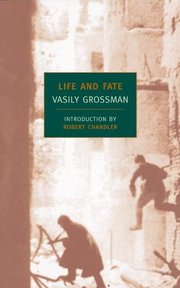
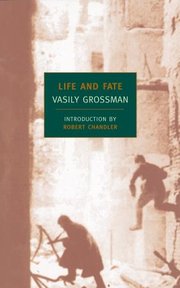
Life and Fate [Zhizn' i sud'ba] (NYRB Classics, 2006)
by Vasily Grossman [translated from the Russian by Robert Chandler]
USSR, 1960

As an out of sequence addendum to my four previous posts on Life and Fate, I'd just like to put in a quick plug for translator Robert Chandler's excellent 20-page introduction, "'Speaking for Those Who Lie in the Earth': The Life and Work of Vasily Grossman": the centerpiece of a critical apparatus which also includes a short piece on the historical background to the work, a note on the text and the translation, and a page of bibliographical recommendations entitled "A Few Books about Stalinist Russia and Vasily Grossman." For those who aren't all that familiar with either Grossman or his doorstopper of a novel, here are a few of the more salient biographical and/or textual tidbits cribbed from Chandler's intro to help contextualize the Soviet writer's masterpiece.  To begin with, Chandler notes that Grossman's mother, Yekaterina Savelievna Grossman, the dedicatee of Life and Fate, was killed by the Germans in September 1941 in Berdichev, Grossman's Ukrainian birthplace, "along with most of the other 30,000 Jews who lived [there]" (x-xi).  Guilt over his failure to see that his mother was safely evacuated, together with his firsthand observations of the evidence of the large-scale Nazi butchery committed at Babi Yar and Treblinka after the tide of the war had turned, appear to have fortified Grossman's resolve to provide witness as a journalist and a novelist "on behalf of those who lie in the earth" as he once wrote to a colleague (xxiv).  Chandler also claims that Grossman's war reporting made him one of the first people to provide an account of the Shoah anywhere and that his 1944 article "The Hell of Treblinka," "the first article in any language about a Nazi death camp," was accordingly "republished and used as testimony in the Nuremberg trials" (xiii).  Unfortunately for Grossman and regardless of the importance of his reporting, "the official Soviet line, however, was that all nationalities had suffered equally under Hitler; the standard retort to those who emphasized the suffering of Jews was 'Do not divide the dead!'" (ibid.).  Still, after Stalin's death in 1953 and Khrushchev's denunciation of Stalin in 1956, Grossman and some other public intellecuals apparently believed that criticisms of the Soviet régime such as those launched by Life and Fate might finally receive a more tolerant public hearing under Khrushchev's "Thaw."  Grossman misread the political tea leaves, though, and Life and Fate was itself arrested.  Here's Chandler's telling of the story:

In February 1961, three KGB officers came to the flat to confiscate the manuscript and any other related material, even carbon paper and typing ribbons.  This is only one of two occasions when the Soviet authorities "arrested" a book rather than a person; no other book, apart from The Gulag Archipelago, was ever considered so dangerous (xv-xvi).

Grossman, who'd been told by the powers that be that his dangerous book couldn't be published for another 200 or 300 years, understandably was crushed, complaining to a friend: "They strangled me in a dark corner" (xvii).  However, other copies of the manuscript, a work that Chandler argues "is important not only as literature but also as history; we have no more complete picture of Stalinist Russia" (xiv-xv), would be smuggled outside of the country and survive to see the light of day after Grossman himself had died.  As a final tribute to Grossman, whose bravery and passion as a novelist really got to me during my reading of and thinking about Life and Fate, I hope you'll forgive me the relaying of one last telling detail from Chandler.  After speaking about the novelist's belief that it was the victims themselves, all the dead but naturally closest to home his mother, who inspired and sustained him to help "fulfill his duty toward the living," Chandler shares this poignant anecdote about Grossman's appeal to Khrushchev about the death sentence given his work (xxiv-xxv):

Grossman's feelings are revealed still more closely in the letter he wrote to his mother on the twentieth anniversary of her death: "I am you, dear Mama, and as long as I live, then you are alive also.  When I die you will continue to live in this book, which I have dedicated to you and whose fate is closely tied to your fate."  His sense of his mother's continued life in the book seems to have made him feel that Life and Fate was itself a living being.  His letter to Khrushchev ends with a challenge:  "There is no sense or truth in my present position, in my physical freedom while the book to which I dedicated my life is in prison.  For I wrote it, and I have not repudiated it and am not repudiating it....  I ask for freedom for my book.

Links
 It isn't difficult to find information about Life and Fate online.  However, I intend to add links to several bloggers I read who have written about the work (if you wind up on the list but don't want to be, just let me know).  Also, please note that Caroline of Beauty Is a Sleeping Cat will be hosting a group read of Grossman's Everything Flows in late October as part of her Literature and War Readalong 2013.  Hope you can join in.

Dwight, A Common Reader

Himadri, The Argumentative Old Git
"The earth does not want to keep secrets": the writings of Vasily Grossman

Lisa Hayden Espenschade, Lizok's Bookshelf
World War 2, Life, Fate, and Spiritual Entropy

Lisa Hill, ANZ LitLovers LitBlog
Life and Fate, by Vasily Grossman 

Pollo, 0 en literatura
¿Qué nos jugamos esta semana?  Vida y destino

viernes, 1 de marzo de 2013

Life and Fate: A Wrap-Up Post of Sorts

Life and Fate [Zhizn' i sud'ba] (NYRB Classics, 2006)
by Vasily Grossman [translated from the Russian by Robert Chandler]
USSR, 1960

Life and Fate, like many other winning books I've read since taking up the loser's hobby that is blogging, is just too big and too overwhelming an opponent for me to adequately deal with in a limited number of posts.  I surrender.  As part of my exit strategy for the novel, though, I'd like to say a few final words about the work here now before returning for one last post on translator Robert Chandler's introduction and some links to other bloggers' reviews of this book later.  To begin with, one of the things I feel I haven't emphasized about the novel is that it makes for surprisingly quick reading despite its massive size and the traumatic nature of much of its subject matter.  Part of this has to do with Grossman's "journalistic" style.  He isn't difficult to read in the manner of a Joyce or a Proust, for example.  Part of this has to do with Grossman's ability to peer into the abyss without looking away--his passages on the Shoah, while emotionally taxing, are nonetheless riveting.  And yet another part has to do with the occasionally bookish, often dramatic conversations his characters engage in.  Here in a scene from Part One, set in Kazan during the heart of the war, is an acquaintance of Viktor Shtrum's, the historian Leonid Sergeyevich Madyarov, going off on a drunken rant about Chekhovian humanism after the small circle of friends gathered at his brother-in-law's house has been debating the virtues of "reactionary" literature vs. the state-sanctioned Social Realism:

Chekhov brought Russia into our consciousness in all its vastness--with people of every estate, every class, every age...  More than that!  It was as a democrat that he presented all these people--as a Russian democrat.  He said--and no one had said this before, not even Tolstoy--that first and foremost we are all of us human beings.  Do you understand?  Human beings!  He said something no one in Russia had ever said.  He said that first of all we are human beings--and only secondly are we bishops, Russians, shopkeepers, Tartars, workers.  Do you understand?  Instead of saying that people are good or bad because they are bishops or workers, Tartars or Ukrainians, instead of this he said that people are equal because they are human beings.  At one time people blinded by Party dogma saw Chekhov as a witness to the fin de siècle.  No.  Chekhov is the bearer of the greatest banner that has been raised in the thousand years of Russian history--the banner of a true, humane, Russian democracy, of Russian freedom, of the dignity of the Russian man.  Our Russian humanism has always been cruel, intolerant, sectarian.  From Avvakum to Lenin our conception of humanity and freedom has always been partisan and fanatical.  It has always mercilessly sacrificed the individual to some abstract idea of humanity.  Even Tolstoy, with his doctrine of non-resistance to Evil, is intolerant--and his point of departure is not man but God.  He wants the idea of goodness to triumph.  True believers always want to bring God to man by force; and in Russia they stop at nothing--even murder--to achieve this (283).

For those new to Life and Fate, Madyarov's monologue may seem interesting as far as these things go but perhaps politically out of step with the era given the level of repression that was known to have existed.  For those following the novel more closely, it will come as no surprise that almost every character present at the gathering will later live in fear that at least one of those present--including even Madyarov himself--might in fact have been an informer for the NKVD secret police.

In addition to the penetrating psychology and the talky dialogue on display above, another arresting weapon in Grossman's style arsenal is the way he authoritatively moves from one abbreviated chapter to the next, arranging and rearranging jigsaw pieces for the reader to make sense of, hand grenading the text as he toggles back and forth between narrator and lecturer functions.  Here, for example, are several soundbites lifted from Part Two, Chapter 31: a disquieting three-page digression on anti-Semitism sandwiched in between two narrative chapters on Eichmann's visit to a concentration camp and the Soviet army's preparations for a stealth attack on the German forces massed at the Volga:  

"Anti-Semitism can take many forms--from a mocking, contemptuous ill-will to murderous pogroms."
 "Anti-Semitism is always a means rather than an end; it is a measure of the contradictions yet to be resolved.  It is a mirror for the failings of individuals, social structures and State systems.  Tell me what you accuse the Jews of--I'll tell you what you're guilty of."
"Anti-Semitism is also an expression of a lack of talent, an inability to win a contest on equal terms--in science or in commerce, in craftsmanship or in painting.  States look to the imaginary intrigues of World Jewry for explorations of their own failure."
"When the Renaissance broke in upon the Catholic Middle Ages, the forces of darkness lit the bonfires of the Inquisition.  These flames, however, not only expressed the power of evil, they also lit up the spectacle of its destruction.
In the twentieth century, an ill-fated nationalist regime lit the bonfires of Auschwitz, the gas ovens of Lyublinsk and Treblinka.  These flames not only lit up Fascism's brief triumph, but also foretold its doom.  Historical epochs, unsuccessful and reactionary governments, and individuals hoping to better their lot all turn to anti-Semitism as a last resort, in an attempt to escape an inevitable doom."

These pronouncements, taken from pages 484-486, punctuate the narrative sections of the text and amplify the bracing qualities of the novel as a whole.  In a novel that describes the horrors of two competing political systems at war, it's worth repeating that Grossman rarely demonizes the foreign enemy without also castigating the enemy at home.

To provide one last example of the satisfyingly rich complexity which which Grossman operates as a novelist, I'd like to turn to a dialogue in Part Three where the increasingly depressed and guilt-ridden scientist Viktor Shtrum meets with the former director of his institute, Dmitry Petrovich Chepyzhin, who has been forced into early retirement for political reasons.  Chepyzhin, who as a matter of conscience chose not to pursue any research relating to nuclear fission because of his concerns about how the research would be used, has tried to cheer Viktor up with an idealistic speech about how one day science and reason will permit man "to solve the problems that were beyond God."  Viktor, a man who is being squeezed by the state to sacrifice his ideals in order to pursue his love of science, wants no part of this pep talk from his former colleague and close friend (691-692):

'Dmitry Petrovich,' he said, 'when you began, I was thinking that I might be arrested any day and that I wasn't in the mood for philosophy.  Suddenly I quite forgot about Kovchenko, Shishakov and comrade Beria; I forgot that I might be thrown out of my laboratory tomorrow and into prison on the following day.  But what I felt as I listened to you was not joy, but utter despair.  We think we're so wise--to us Hercules seems like a child with rickets.  And yet on this very day the Germans are slaughtering Jewish children and old women as though they were mad dogs.  And we ourselves have endured 1937 and the horrors of collectivization--famine, cannibalism and the deportation of millions of unfortunate peasants...  Once, everything seemed simple and clear.  But these terrible losses and tragedies have confused everything.  You say man will be able to look down on God--but what if he also becomes able to look down on the Devil?  What if he eventually surpasses him?  You say life is freedom.  Is that what people in the camps think?  What if the life expanding through the universe should use its power to create a slavery still more terrible than your slavery of inanimate matter?  Do you think this man of the future will surpass Christ in his goodness?  That's the real question.  How will the power of this omnipresent and omniscient being benefit the world if he is still endowed with our own fatuous self-assurance and animal egotism?  Our class egotism, our race egotism, our State egotism and our personal egotism?  What if he transforms the whole world into a galactic concentration camp?  What I want to know is--do you believe in the evolution of kindness, morality, mercy?  Is man capable of evolving in that way?

A moment later, Viktor apologizes to Chepyzhin for browbeating him with this "abstract" tirade.  A few pages later, he leaves his friend's house in tears--overwhelmed and possibly a broken man.  What does all this have to do with Stalingrad in 1942-1943?  A hundred pages later, Grossman provides an ambiguous but decidedly unheroic answer in this coda to the armed confrontation between two state terror systems and an uncertain future in which millions of people could suddenly cease to exist while the world looked on: "Every epoch has its own capital city, a city that embodies its will and soul.  For several months of the Second World War this city was Stalingrad" (796).

Red Army soldiers from the "Stalingrad Academy of Street-Fighting"
(December 1942, photographer unknown)

miércoles, 27 de febrero de 2013

Life and Fate: Part Three

Life and Fate [Zhizn' i sud'ba] (NYRB Classics, 2006)
by Vasily Grossman [translated from the Russian by Robert Chandler]
USSR, 1960

How can one convey the feelings of a man pressing his wife's hand for the last time?  How can one describe that last, quick look at a beloved face?  Yes, and how can a man live with the merciless memory of how, during the silence of parting, he blinked for a moment to hide the crude joy he felt at having managed to save his life?  How can he ever bury the memory of his wife handing him a packet containing her wedding ring, a rusk and some sugar-lumps?  How can he continue to exist, seeing the glow in the sky flaring up with renewed strength?  Now the hands he had kissed must be burning, now the eyes that had admired him, now the hair whose smell he could recognize in the darkness, now his children, his wife, his mother.  How can he ask for a place in the barracks nearer the stove?  How can he hold out his bowl for a litre of grey swill?  How can he repair the torn sole of his boot?  How can he wield a crowbar?  How can he drink?  How can he breathe?  With the screams of his mother and children in his ears?
(Life and Fate, 540-541)

One of the testaments to the monumentality of Life and Fate as a novel and to the vitality of Vasily Grossman's moral compass as a novelist is that Part Three of the work doesn't exactly end on a happy note with the eventual Russian victory at Stalingrad.  There's no victory lap for the survivors. Instead, Grossman spends much of the final third of his excellent but truly unsettling epic making pointed moral equivalencies between the state terror sponsored by the Third Reich and the state terror sponsored by the Stalinist Soviet Union.  To this end, he's so effective at highlighting the pressure put on individuals to bow to forces beyond their control that horrifying passages like the excerpt from Part Two above--just one of many powerful scenes from Life and Fate where the novelist confronts the Shoah head on--eerily foreshadow the homegrown attempts by the victorious Soviet state to crush the spirit and snuff out the lives of their own citizens on trumped-up charges of collaboration and "defeatist" or anti-Soviet thinking.  Colonel Pyotr Pavlovich Novikov, the commander of a tank corps in large part responsible for the defeat of the German General Friedrich Paulus' 6th army, is relieved from his command shortly after his outfit's heroic efforts in the so-called Great Patriotic War.  His alleged crime against the state?  To prevent unnecessary casualties to his men, he had delayed his otherwise miraculously successful advance for a few minutes despite instructions to the contrary from his superiors to permit the Soviet artillery to clear out remaining pockets of German resistance prior to issuing orders for the attack.  Nikolay Grigorevich Krymov, a relatively upstanding party commisar who had also risked his life at Stalingrad, winds up in Moscow's Lubyanka Prison being beaten to a pulp and resuscitated by drugs so he can sustain more beatings from thuggish lackeys until he will confess to a "crime" of which he is innocent.  Could his ex-wife, with whom he is still in love, really be the one who denounced him?  Viktor Pavlovich Shtrum, the celebrated atomic physicist, is twice asked to make false statements that will save his career and livelihood at the expense of condemning the lives of others.  With whisperers everywhere, it's impossible to overstate the claustrophobic and paranoiac tension in the narrative when the character receives a phone call from Stalin himself: "Good day, comrade Shtrum" (762). Is this what victory is supposed to look like?  Grossman, who in a historian-like mode near the end posits that "the outcome of this battle was to determine the map of the post-war world, to determine the greatness of Stalin or the terrible power of Adolph Hitler" and that "Stalingrad was to determine future social systems and philosophies of history" (860), offers up an old-fashioned humanist's vision of victory--its meaning and its attainability, as packaged with the survivor's guilt that comes with it--in the ensuing passage in which the 70-something Alexandra Vladimirovna Shaposhnikova first returns to what's left of her bombed-out house in the city after the war (861-862):

And here she was, an old woman now, living and hoping, keeping faith, afraid of evil, full of anxiety for the living and an equal concern for the dead; here she was, looking at the ruins of her home, admiring the spring sky without knowing that she was admiring it, wondering why the future of those she loved was so obscure and the past so full of mistakes, not realizing that this very obscurity and unhappiness concealed a strange hope and clarity, not realizing that in the depths of her soul she already knew the meaning of both her own life and the lives of her nearest and dearest, not realizing that even though neither she herself nor any of them could tell what was in store, even though they all knew only too well that at times like these no man can forge his own happiness and that fate alone has the power to pardon and chastise, to raise up to glory and to plunge into need, to reduce a man to labour-camp dust, nevertheless neither fate, nor history, nor the anger of the State, nor the glory or infamy of battle has any power to affect those who call themselves human beings.  No, whatever life holds in store--hard-won glory, poverty and despair, or death in a labour camp--they will live as human beings and die as human beings, the same as those who have already perished; and in this alone lies man's eternal and bitter victory over all the grandiose and inhuman forces that have ever been or will be...

Vasily Grossman (1905-1964)

I think I have one or maybe two more posts on Life and Fate left in me before finally saying goodbye to this book for the time being.  Hope to talk about Robert Chandler's introduction and the BBC radio adaptation of the novel.  Also intend to link to fellow bloggers' posts on the work since they, like the many inspirational ones contributed by Dwight of A Common Reader that I've been eagerly devouring this month, are sure to touch on important things I ran out of time for here or just otherwise missed.  Great, great book.

viernes, 22 de febrero de 2013

Life and Fate: Part Two

Life and Fate [Zhizn' i sud'ba] (NYRB Classics, 2006)
by Vasily Grossman [translated from the Russian by Robert Chandler]
USSR, 1960

In my previous post on Part One of Life and Fate, I was wondering aloud what Vasily Grossman--an eyewitness to much of the Stalingrad siege of 1942-1943 and later the fall of Berlin in 1945 in his capacity as a war correspondent embedded with the Red Army--might have hoped to achieve with his novel that he couldn't have achieved in a work more closely aligned with a nonfiction format.  Having now completed two of the novel's three parts, I think I have a slightly better handle on some of the reasons for Grossman's choice of genre.  One of the obvious motivating factors seems to have been the scale of the challenge the novelist set for himself.  Part One of the nearly 900 page long novel, for example, ends with the betrayal of the "old Bolshevik" Mikhail Sidorovich Mostovskoy in a German concentration camp.  Part Two ends with the death of a young Soviet pilot, Lieutenant Viktorov, in combat near Stalingrad during the desperate winter counterattack that will eventually lead to the Russian encirclement of the German 6th Army besieging the city.  In between and all along up to this point in the novel, in fact, Grossman makes use of a single family, the Shtrum/Shaposhnikovas, and their acquaintances in combination with the war at Stalingrad as the dual focal points for a narrative which touches on an entire country at war and freely mixes the use of fictional and historical characters.  A nonfiction approach, while perhaps more authentic on paper to the history purist, would have made the sweep of Life and Fate more difficult for Grossman to realize.  In addition, Grossman's novelization of this material--the war, the Holocaust, the constant, almost paranoid fear of saying the wrong thing to the wrong person in the Stalinist Soviet Union of the time, the references to the repression experienced by the Soviet people during the collectivization efforts of the 1930s--also often achieves an emotional immediacy that a strictly nonfiction approach wouldn't have permitted in quite the same way.  For someone who tends to be dismissive of mass market historical fiction for its costume drama tendencies, it kind of irks me to admit this.  However, Grossman's so-called historical fiction, as informed by his war reporting, is thankfully far, far different from the norm I read about elsewhere.  The chapters where he writes about Eichmann enjoying a repast of hors-d'oeuvres and wine in the middle of a gas chamber or walks you into the gas chamber and describes how a kindly character now "had no future, only a past" (543) are just devastating despite only being fiction.  But why take my word for it?  Here's a single extended example from Part Two where Grossman, who elsewhere has evoked "the remorseless cunning of History" (488) in asides about civilians and soldiers trapped in an especially unforgiving experiment in total war, effectively employs the tools of fiction in the service of a larger historical truth.  Doctor Sofya Levinton, a Soviet Jew, in the gas chamber with a six year old boy she has sought to comfort to the end (553-554):

Her eyes--which had read Homer, Izvestia, Huckleberry Finn and Mayne Reid, that had looked at good people and bad people, that had seen the geese in the green meadows of Kursk, the stars above the observatory at Pulkovo, the glitter of surgical steel, the Mona Lisa in the Louvre, tomatoes and turnips in the bins at market, the blue water of Issyk-Kul--her eyes were no longer of any use to her.  If someone had blinded her, she would have felt no sense of loss.
She was still breathing, but breathing was hard work and she was running out of strength.  The bells ringing in her head became deafening; she wanted to concentrate on one last thought, but was unable to articulate this thought.  She stood there--mute, blind, her eyes still open.
The boy's movements filled her with pity.  Her feelings towards him were so simple that she no longer needed words and eyes.  The half-dead boy was still breathing, but the air he took in only drove life away.  His head was turning from side to side; he still wanted to see.  He could see people settling onto the ground; he could see mouths that were toothless and mouths with white teeth and gold teeth; he could see a thin stream of blood flowing from a nostril.  He could see eyes peering through the glass; Roze's inquisitive eyes had momentarily met David's.  He still needed his voice--he would have asked Aunt Sonya about those wolf-like eyes.  He still even needed thought.  He had taken only a few steps in the world.  He had seen the prints of children's bare heels on hot, dusty earth, his mother lived in Moscow, the moon looked down and people's eyes looked up at it from below, a teapot was boiling on the gas-ring...  This world, where a chicken could run without its head, where there was milk in the morning and frogs he could get to dance by holding their front feet--this world still preoccupied him.
All this time David was being clasped by strong warm hands.  He didn't feel his eyes go dark, his heart become empty, his mind grow dull and blind.  He had been killed; he no longer existed.
Sofya Levinton felt the boy's body subside in her arms.  Once again she had fallen behind him.  In mine-shafts where the air becomes poisoned, it is always the little creatures, the birds and mice, that die first.  This boy, with his slight, bird-like body, had left before her.
'I've become a mother,' she thought.
That was her last thought.
Her heart, however, still had life in it: it contracted, ached and felt pity for all of you, both living and dead; Sofya Osipovna felt a wave of nausea.  She pressed David, now a doll, to herself; she became dead, a doll.

viernes, 15 de febrero de 2013

Life and Fate: Part One

Life and Fate [Zhizn' i sud'ba] (NYRB Classics, 2006)
by Vasily Grossman [translated from the Russian by Robert Chandler]
USSR, 1960

I don't see how Vasily Grossman could possibly keep up this sort of a punishing pace over the course of 871 pages, but Part One of his posthumous epic centered on the siege of Stalingrad but thoroughly consumed with what he calls "the tragedy of the twentieth century" (33)--completed in 1960, confiscated in 1961, but never published in his lifetime due to its ideologically incorrect critique of Stalinist excesses--casts him in the role of a heavyweight prize fighter swinging devastating haymakers right from the sound of the opening bell.  Even when his opponent, the reader, knows what's coming next, Grossman keeps relentlessly cutting off the ring and raining down murderous verbal punches one after another.  You have no choice in the matter but to absorb the beating or to stop reading.  Of course, the brutal "beauty" of Grossman's approach lies in its utter conviction and in its appalling honesty; he doesn't seem to be holding back at all, to be saving anything for the last round.  And why should he?  "Before the war this camp had been known as a camp for political criminals," he writes about a German concentration camp.  "National Socialism had created a new type of political criminal: criminals who had not committed a crime" (21).  "On the fifteenth of September last year I watched twenty thousand Jews being executed--women, children and old men," says one former preacher of the Gospel.  "That day I understood that God could not allow such a thing and that therefore he did not exist" (28).  Viktor Shtrum, a Russian physicist who before the war had never thought about the fact that he and his mother were both Jews, is forced to ponder the inherent irony of the situation when a farewell letter from his mother arrives announcing her imminent death after having been trapped behind German lines and placed in a Jewish ghetto cut off from the outside world by barbed wire: "The century of Einstein and Planck was also the century of Hitler.  The Gestapo and the scientific renaissance were children of the same age.  How humane the nineteenth century seemed, that century of naïve physics, when compared with the twentieth century, the century that had killed his mother" (94).  Naum Rozenberg, an accountant on his way to the gas chamber, for his part inspires an anecdote about the cremation methodologies used in his new occupation until there are no bodies left for him to desecrate but his own: "First they laid dry wood over the ventilation-ditches, then a layer of oak logs--they burned well--then women who'd been killed, then more wood, then the bits of human bodies that were left over, then a can of petrol, and then right in the middle, an incendiary bomb.  Then the Scharführer gave the order; the guards were already smiling as the brenners shouted out; 'It's alight!'  Finally, the ash was shoveled back into the grave.  And it was quiet again.  It had been quiet before and it was quiet again" (201-202).  Given the depressing nature of many of these vignettes, some may wonder whether Grossman is worth reading at all.  Others may merely wonder what the novel format can offer in lieu of non-fiction testimony regarding these horrific truths.  To try to answer the first question in the affirmative while trying to buy more time for the second question until I have a chance to get further into the narrative, for now I'll merely note that Grossman's characters are often so "human" that they're easy to relate to even when their circumstances aren't; this scene, set in House 6/1 at Stalingrad where a beleaguered group of Russian soldiers seems to be the only thing keeping the remainder of the Russian forces from being pushed into the Volga by the superior firepower of the Germans, made me laugh unexpectedly: "Far from terrifying the inmates of the building, the German attacks only succeeded in arousing a certain condescending irony: 'Hm, the Fritzes really are having a go at it today!'  'Look what those maniacs are doing now!'  'The fool--where does he think he's dropping his bombs?'"  (258).  Also, there's no shortage of War and Peace-like attempts by Grossman to understand the complicity of those involved as participant witnesses to the wholesale slaughter.  In Chapter 50, for example, he draws a parallel between the slaughter of infected cattle and the extermination of the Jews by the Germans and of the kulaks and the Trotskyists by Stalin.  How was the large-scale social buy-in achieved?  Without pulling any punches yet again, Grossman, a Ukrainian Jew himself, explains it as follows:

Experience showed that such campaigns make the majority of the population obey every order of the authorities as though hypnotized.  There is a particular minority which actively helps to create the atmosphere of these campaigns: ideological fanatics; people who take a bloodthirsty delight in the misfortunes of others; and people who want to settle personal scores, to steal a man's belongings or take over his flat or job.  Most people, however, are horrified at mass murder, but they hide this not only from their families, but even from themselves.  These are the people who filled the meeting-halls during the campaigns of destruction; however vast these halls or frequent these meetings, very few of them ever disturbed the quiet unanimity of the voting.  Still fewer, of course, rather than turning away from the beseeching gaze of a  dog suspected of rabies, dared to take the dog in and allow it to live in their houses.  Nevertheless, this did happen (213-214).

Taken out of context, the final line above seems to provide a hint of relief.  Grossman, however, keeps probing, jabbing at the ethical scab until it bleeds.  More on the remainder of the pugilistic Life and Fate over the next couple of weeks.

Vasily Grossman (1905-1964) in his war correspondent days