lunes, 4 de noviembre de 2013

Help a él

Help a él (Alfaguara, 2009)
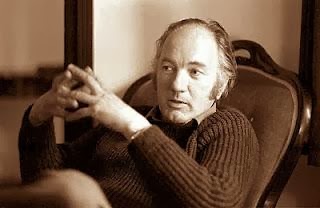
by Fogwill
Argentina, 1983

One of the more curious things I've seen Borges taken to task for over the years is the idea that his oeuvre is so lacking in sex and romance that it might almost be classified as asexual as a whole.  Fortunately for Borges and his admirers, in the Argentinean Literature of Doom: Año 2 year of 1983, Fogwill came to JLB's rescue so to speak with this graphic sex-ridden, scatological, and drug use-filled parody of Borges' "El aleph" in which a vibrator referred to as "el concejal" ["the Town Councillor"] plays an all too prominent role.  Shall I continue?  Although I'm not sure how many other people could have even dreamed up a Borges meets Osvaldo Lamborghini hallucination of this nature, Fogwill mostly pulls it off with a pair of nifty Borgesian anagrams (Help a él = "El aleph," of course, and the narrator's suicide muse Vera Ortiz Beti is a not so subtle re-scrambling of "The Aleph"'s Beatriz Viterbo sans the second "B" for Borges, who's never mentioned by name in the novella), a frisky sense of humor, a series of Buenos Aires in-jokes, and a surprisingly tender ending given all the bodily fluid excesses and occasional sadomasochism that precede it.  Those sex scenes are something else, though, and I don't mean that in a good way!  Thankfully, the humor is both verbal and visual: in one instance, the uncle of the narrator's writer friend Laiseca calls his nephew a great writer before quickly adding: "--... Lo que quiere decir --agregó-- que será un perfecto fracasado.  ¡Lástima que la prima no viva para apreciar el éxito de su fracaso...!" ["'Which means,' he added, 'that he'll be a perfect failure.  What a  shame that his aunt isn't alive to witness the success of his failure!'"] (246); in another, the narrator notes how the photos of Evita and Perón on the wall of Laiseca's bedroom are accompanied by others of Mao, Mussolini, Hitler and Oliveira Salazar (249).  The in-jokes, too, are both literary and political.  Adolfo B. Laiseca, the narrator's "perfect failure" of an acquaintance, bears a name that pays homage to both Borges' well-known writer friend Adolfo Bioy Casares and Fogwill's lesser-known writer friend Alberto Laiseca, for example, and there's another reference to an "inédito de Leonor Acevedo, que atesora Piglia" ["an unpublished work by Leonor Acevedo which Piglia possesses"] (261) which would seem to be an approving wink at the stunt that Ricardo Piglia pulled off in 1975 when he published an original novella titled Homenaje a Roberto Arlt [Homage to Roberto Arlt] and passed it off as the critical edition of a lost Arlt manuscript that had just been discovered.  It may help you appreciate Fogwill's literary joke more if you realize that his Arlt, Leonor Acevedo, just happens to share the same maiden name as Borges' mother; similarly, it may help you appreciate Fogwill's edgy political game more if you realize that the name of Vera Ortiz Beti's friend, Idische Zeitung, was the name of a Buenos Aires Yiddish weekly that was once closed down by the military government in the 1940s and that another minor character is an arms importer who likes to play cards at the nearby naval base.  Considering that Fogwill's previous claims to fame for me were the writing of "Muchacha punk" (one of my all-time favorite short stories), the penning of Los pichiciegos (one of my all-time favorite Spanish-language novels), and the nicknaming of García Márquez as García Marketing (one of my all-time favorite dismissive nicknames), I'd have to say that even though Help a él doesn't quite resonate for me at those same sorts of levels, it's still quite the one-stop shopping experience for anyone desiring a late Dirty War era read that insults "turistas argentinoides" ["Argentinoid tourists"] playing Beatles songs  in Uruguay (242) and riffs on the concepts of Buenos Aires as a "puerta falsa en el tiempo" ["trap door in time"] (Ibid.)) and the way that the dead live on in "las memorias y las fabulaciones de los vivos" ["the memories and the inventions of the living"] (284) all while--hmm, how can I put this delicately?--sexing Borges' cherry.

Source
Help a él appears on pages 235-284 of the Fogwill anthology Cuentos completos (Buenos Aires: Alfaguara, 2009).  Naturally, this novella (and hardly anything else for that matter by the mighty Fogwill [1941-2010]) isn't yet available in English translation.

viernes, 1 de noviembre de 2013

German Literature Month, the Argentinean Literature of Doom: Año 2, and the 2014 Caravana de recuerdos Ibero-American Readalong


With Novemberfest suddenly upon us, I'd like to put in a belated plug for the German Literature Month festivities being hosted by Caroline of Beauty Is a Sleeping Cat and Lizzy of Lizzy's Literary Life.  Still not sure what I'm going to read for the event this time around, but I'm guessing that this is probably a good excuse to indulge in some more vitriol from our good friend Karl Kraus in between the more civilized Fausts and the Magic Mountains and the Julius Echter Hefe-Weissbiers and whatnot.
*
Speaking of civilization and barbarism, I'd rudely almost forgotten that the motorcade for the 2013 expedition to the lands of the Argentinean Literature of Doom was almost two months behind schedule.  What a boludo!  That said, the 2012 ALoD intro post should still explain the concept well enough for anybody with too much time on their hands.  But for you, the impatiently clock-watching and coffee-swilling bloghopping aesthete, here's an even shorter explanation: you either read and write about any piece of Argentinean literature in November or December and then tell me about it so I can include a link in a monthly wrap-up post or you challenge me to read and write about any piece of Argentinean literature with you at a mutually agreeable time in November or December and then we both blog about it and I include the links in a monthly wrap-up post.  Not sure what to read?  Of course, everybody who is somebody needs to read Roberto Arlt's mad, iconic doom bible Los siete locos [The Seven Madmen] at some point in their reading lives.  But here are some other worthwhile ideas from last year's intrepid ALoD participants:

Amateur Reader (Tom), Wuthering Expectations

Miguel, St. Orberose

Richard, Caravana de recuerdos
Facundo.  Civilización y barbarie by Domingo Faustino Sarmiento
Siete noches by Jorge Luis Borges
Boquitas pintadas by Manuel Puig
Cómo me hice monja by César Aira
La Vida Nueva by César Aira
"El Fiord" by Osvaldo Lamborghini

Rise, in lieu of a field guide
This Craft of Verse by Jorge Luis Borges
"The Golden Hare" by Silvina Ocampo

Séamus, Vapour Trails
Hopscotch by Julio Cortázar
**
Too pressed for time to participate in the Argentinean Literature of Doom: Año 2 in November or December on such short notice?  No worries because the ALoD: A2 will unofficially morph into the 2014 Caravana de recuerdos Ibero-American Readalong in January (clarification: for our purposes, "Ibero-American" will be defined as having to do with all literature produced on the Iberian Peninsula--i.e. in addition to works written in the Romance languages, also including those composed in Arabic, Basque, Hebrew, and Latin--and all literature from the Spanish- and Portuguese-speaking countries in the Americas).  In other words, you have a full 14 months to read at least one measly Argentinean short story, poem, novel, or screed with me and only two months less than that to read something from one of the other countries' bodies of work.  So although what follows is a full year of structured group reads planned for 2014, I foolishly remain open to being challenged to read any other Ibero-American work of literature of your choice not penned by obvious losers.  More details on all this in a moment, but without further ado here are the titles I invite you to read along with me:

JANUARY-FEBRUARY
Roberto Bolaño's 2666 [2666]
Spain/Chile, 2004

FEBRUARY
Ibn Hazm de Córdoba's Tawq al-Hamamah [Spanish: El collar de la paloma; English: The Ring of the Dove]
Al-Andalus, c. 1022

MARCH
José Saramago's O Ano da Morte de Ricardo Reis [The Year of the Death of Ricardo Reis]
Portugal, 1984
*
w/Richard of Shea's Zibaldone
& Rise of in lieu of a field guide

APRIL
The Golden Age: Poems of the Spanish Renaissance
Spain/New Spain, Middle Ages & Siglo de Oro
[translated by Edith Grossman in 2007]

MAY
Augusto Roa Bastos' Yo el Supremo [I, the Supreme]
Paraguay, 1974
*
w/Séamus of Vapour Trails

JUNE
Tirso de Molina's El burlador de Sevilla [The Trickster of Seville]
Spain, c. 1630

JULY
Guillermo Cabrera Infante's Tres tristes tigres [Three Trapped Tigers]
Cuba, 1967
*
w/Richard of Shea's Zibaldone
 

AUGUST
Jose Hernández's Martín Fierro [The Gaucho Martín Fierro]
Argentina, 1872 & 1879

SEPTEMBER
Macedonio Fernández's Museo de la novela de la Eterna [The Museum of Eterna's Novel (The First Good Novel)]
Argentina, 1967 [posthumous]

OCTOBER
Nicanor Parra's Poemas y antipoemas [Poems and Antipoems]
Chile, 1954
* 

NOVEMBER-DECEMBER
Miguel de Cervantes' Don Quijote de la Mancha [Don Quixote]
Spain, 1605 & 1615
*
w/Richard of Shea's Zibaldone
& Scott of seraillon

DECEMBER
Juan Rulfo's El Llano en llamas [The Plain in Flames and/or The Burning Plain and Other Stories]
Mexico, 1953
 
Although I respect you all too much to shill for these books too shrilly (i.e. it's getting late, and it's time to put this post to bed), I thought I'd say a couple of words about why I decided on these particular titles for the poorly-named Ibero-American Readalong.  The Bolaño, the Ibn Hazm, and the Cervantes are all favorites that I've been meaning to reread for a while.  I'd imagine that the Ibn-Hazm is the least well known of the three to most Caravana readers, so I'll just mention that it's a "treatise on love" originally written in Arabic poetry and prose that I really enjoyed the first time around.  Naturally, it's doing double duty here as a work from "medieval Spain" [sic] and as a representative of the various non-Spanish language literatures of the Iberian Peninsula.  The Saramago, Roa Bastos, Cabrera Infante, and Macedonio Fernández novels, on the other hand, are just works that I've long wanted to read--with the exception of The Year of the Death of Ricardo Reis, which is more of a recent obsession thanks to Miguel of St. Orberose's Saramago writing rampage a while back.  I'd initially thought about including Machado de Assis' 1891 Quincas Borba to add a Brazilian and a 19th century novel to the list, but in the end I couldn't resist the idea of substituting Borges acquaintance Macedonio Fernández's Museo de la novela de la Eterna instead because the idea of a "novel" full of some 50 prologues seemed too good a provocation to pass up on (of course, I realize that if my provocation is successful enough, I might end up reading Macedonio alone).  The poetry choices, all highly recommended by Tom of Wuthering Expectations by the way, are mostly dehumiliations years in the making.  The exception here is the Grossman anthology, much of which I believe I've read before, but that should make a nice intro to Siglo de Oro poetry newcomers and a nice refresher for me--especially since I usually dodge poetry on the blog. I also hope to add another short Sor Juana piece or two to the mix if things work out. Finally, El burlador de Sevilla (frequently attributed to Tirso de Molina) and Juan Rulfo's El Llano en llamas are here to represent Spain's Golden Age theater and the Latin American short story respectively.  Having read many if not most of the Rulfo stories before, I thought that the writer's lean, austere writing style might make a nice epilogue to the showy pyrotechnics of Don Quijote.  In any event, that was the plan.

Details
If you're interested in reading any of these with me, please note that I intend to post on most of them within the last three days of the month in question.  Barring the occasional procrastination,  I'll round up links at that time and include them on my review posts for discussion.  A few exceptions: 2666 will be split up into parts 1-3 in January (ending with "The Part about Fate") and parts 4-5 in February (beginning with "The Part about the Crimes").  Since I'll also be reading Ibn Hazm in February, I might post on one or the other work during the last week of the month rather than just the last three days.  By all means, post whenever you want to throughout the readalong, though.  Similarly, Don Quijote will be split up into Book I (the 1605 work) in November and Book II (the 1615 work) in December.  I'll likely post on Rulfo's stories after I finish the Cervantes, but do whatever works for you if you're joining for both.  If you're not interested in any of these titles but you're interested in challenging me to something not on the menu, just get in touch by e-mail or with a comment so we can work something out.  I would have loved to have included something by Onetti or Saer or a Catalan author, for example, but there just weren't enough months in the year.  Any takers?


domingo, 13 de octubre de 2013

The Prime of Miss Jean Brodie

The Prime of Miss Jean Brodie (Harper Perennial Modern Classics, 2009)
by Muriel Spark
Scotland, 1961

Considering the ridiculous # of times I've put off hooking up w/reputed brainy vixen Muriel Spark despite the enthusiastically proffered introductions of high class book pimps like Frances of Nonsuch Book and Séamus of Vapour Trails, I guess I only have myself to blame for this long-overdue admission: man, am I smitten...in terms more properly suited to this quick-reading but thorny morality tale set in 1930s Edinburgh at the Marcia Blaine School for Girls, what I'm trying to get at is that I found The Prime of Miss Jean Brodie to be a superb, surprisingly complex novella that actually manages to live up to its massive hype with a spare, low-key style and an unpredictability that feels organic rather than forced--and even though Spark's authorial voice was every bit as recognizably distinctive as advertised ("flattening their scorn beneath the chariot wheels of her superiority," on page 56, will have to serve as the soundbite du jour), I so enjoyed the rest of her prose while immersed in it that I was variously reminded of Robert Walser's Jakob von Gunten for its unconventional but intensely felt characterization, Virginia Woolf's To the Lighthouse for a deft but devastating fast-forwarding storytelling technique that's used on occasion throughout the work, and Marguerite Duras' Moderato cantabile for the novelist's complete command of her material amid a stripped-down economy of scale...of course, perhaps the easiest way for me to xmit my newfound appreciation for some of the more aesthetically fetching aspects of Spark's contempo classic is to contrast her high degree of difficulty portrayal of the title character, a charismatic and influential teacher who will suffer a betrayal less for her "experimental" pedagogy or for being an open admirer of some of the fascist changes taking place in 1930s Germany, Italy, and Spain and more from the personal animus of a couple of moral fascists including one from within her inner circle, with the light touch evident in this miniaturized portrait of one of Brodie's impressionable young students: "Eunice Gardiner discovered the Industrial Revolution, its rights and wrongs, to such an extent that the history teacher, a vegetarian communist, had high hopes of her which were dashed within a few months when Eunice reverted to reading novels based on the life of Mary Queen of Scots" (87-88).  Intellectually speaking, a hot date.

Muriel Spark (1918-2006)

domingo, 6 de octubre de 2013

The Tragedy of Fidel Castro

The Tragedy of Fidel Castro [A tragédia de Fidel Castro] (River Grove Books, 2012)
by João Cerqueira [translated from the Portuguese by Karen Bennett and Chris Mingay)
Portugal, 2008

"A novel," it says on the front of the book, "alternative history," it says on the back--and who am I to quibble over such a contradictory pair of descriptions?  Lightweight but frequently laugh out loud funny novelization of the history of the surprisingly little known war between JFK and Castro that was mediated by Fátima, Jesus, and, in a scene-stealing cameo, the devil.  While the garish cover and a couple of translation infelicities (the expression "hawks and doves" is repeatedly translated as "falcons and doves," the modern U.S. poor are apparently unironically referred to as "peasants," both of which sound strange to these yanqui ears) probably don't do novelist João Cerqueira any favors, that's too bad because the guy's comedic sensibilities deserve a wider audience--although perhaps the less said about the absurdist plot the better.  Still, it's hard to complain about the gentle ribbing that the bearded characters Castro ("He was always a crook, a hypocrite.  Why does he have a beard in that tropical climate?" [162]) and Christ ("He sat down for his first supper since his last" [134]) take from the clean-shaven Cerqueira or about the medieval barber like bloodletting perpetrated on Castro's Cuba ("Pharmacies empty of medicine, attesting to exemplary levels of public health" [21]) and on churchgoers suffering under "the stony gaze of the malevolent beings imprisoned in the granite of the church walls" ("Resigned, they left the church with little will to reflect upon why some lambs were mystical while others were roasted in the oven with jacket potatoes" [67]).  For readers who like to mix their political satire with their theological satire, there's also a nice two-paragraph disquisition on how "the second coming of Christ was different from the first [other than] that it occurred in another historical period."  Among the similarities: "Women continued to have more faith than men despite being excluded from religious functions; the many religions never agreed on the majority of metaphysical and political matters, despite being in agreement that sex is a great sin; [...] prodigal sons returned home when their money ran out."  Among the differences: "People now fled by plane instead of by donkey; [...] the price of treason was below thirty coins; [...] and people now considered cousins and siblings to be different from each other" (125-126, ellipses added).

João Cerqueira
 
Thanks to the author and his publisher for providing a review copy of what was often a very amusing book.  To keep the Portuguese comedy/realism theme rolling, I'm happy to note that I'll be reading Eça de Queiroz's 1878 Cousin Bazilio [O Primo Basílio] next.

martes, 1 de octubre de 2013

Angle of Repose

Angle of Repose (Penguin Classics, 2000)
by Wallace Stegner
USA, 1971

Considering the degree to which the award-winning American novelist and nonfiction writer and self-proclaimed "westerner for life" [xiii] Wallace Stegner is revered in certain circles today, a disinterested observer might well suspect that John Leonard's 1972 New York Times smackdown of Angle of Repose as "a Pontiac in the age of Apollo, an Ed Muskie in the fiction sweepstakes,"  while undeniably a great piece of trash talk for anybody old enough to appreciate the period insults, is probably a bit harsh in its condemnation of the Pulitzer Prize-winning novel.  However, I'm not so sure that Leonard wasn't on to something.  There is, to be fair, plenty to like about Angle of Repose even if its sprawling, 557-page multigenerational family drama set in various places in the 19th and 20th century American West and Mexico tends to wear mighty thin at times.  I enjoyed, for example, Stegner's fine eye for the surprising but perfectly observed detail ("the hand that held the lines were freckled like tortillas" [173]), his evocation of place and space on both a local and a grand scale, and his curmudgeonly emeritus history professor Lyman Ward's ongoing interrogation of the nature of historical sources (here, musing about his taciturn grandfather's probable response to a key event early in his marriage):  "Or I suppose that is what he felt.  The fact is, I don't know.  He is the silent character in this cast, he did not defend himself when he thought he was wronged, and he left no novels, stories, drawings, or reminiscences to speak for him.  I only assume what he felt, from knowing him as an old man" (223).  In a work that's been both praised and vilified for its uncredited interpolation of first-person historical sources lifted from the letters of the 19th century western writer/illustrator Mary Hallock Foote, though, I found it all too ironic that what should have been the most real life character in this ambitious historical fiction hybrid felt like the most fictional of all regardless of how much her high maintenance ways, her "Quaker 'thee'" grating talking quirk (333), and her quest to bring Eastern civilization to the uncultured West might have mirrored the historical reality.  More to the point re: Stegner's artistic choices, I also felt really let down by the way this initially unpredictable novel of place eventually devolved into a rather pro forma tale of two dysfunctional marriages.  In other words, I'll have to get back to you on whether "a Pontiac in the age of Apollo" actually tells it like it is or is really more like coded 1972 speak for "Jodi Picoult called, and she wants her fucking book back."  Disappointing.

Wallace Stegner (1909-1993)

The underwhelming Angle of Repose was read as part of a conversation with the mighty Séamus of Vapour Trails.  His review can be found here.


miércoles, 25 de septiembre de 2013

Woodcutters

Woodcutters [Holzfällen] (Vintage International, 1988)
by Thomas Bernhard [translated from the German by David McLintock]
Austria, 1984

Vienna is a terrible machine for the destruction of genius, I thought, sitting in the wing chair, an appalling recycling plant for the demolition of talent.  All these people whom I was now observing through their sickening cigarette smoke came to Vienna thirty or thirty-five years ago, hoping to go far, only to have whatever genius or talent they possessed annihilated and killed off by the city, which kills off all the hundreds and thousands of geniuses or talents that are born in Austria every year.
(Woodcutters, 56)

Even though it sometimes seems as if apocalyptic kvetcher Thomas Bernhard might be something of a one-trick pony for his unhinged but been there/done that monologic book-length rants, what a trick--and what a pony!  Woodcutters, the much ballyhooed centerpiece of the writer's so-called arts trilogy, finds the post-Karl Kraus Austrian king of mischief administering a world class beating to the Viennese theater world and its champions and, by extension, lamenting the myriad ways even non-actors and non-artists preference dishonesty over honesty and pretense to reality in their personal dealings.  Who: an unnamed narrator, observing it all from the vantage point of a "hideous" Viennese apartment's wing chair while partaking of copious amounts of expensive champagne.  What: a dinner party from hell, an artistic dinner designed to impress the hosts' status-conscious and/or otherwise shallow friends, with a late-arriving and pretentious actor from the Burgtheater starring as the guest of honor.  When: sometime in the 1980s, around midnight on the evening following the funeral of a friend of many of the dinner guests.  Where: at the Auersbergers' home in the Gentzgasse in Vienna, a place that the narrator hasn't visited for years and wishes he hadn't visited now.  Although a perfectly chosen Voltaire epigraph ("Being unable to make people more reasonable, I preferred to be happy away from them") starts the anti-social ball rolling so to speak, as usual it's Bernhard's agreeably disagreeable narrator who dishes out most of the comedic fun and/or punishment ("To serve potato soup at a quarter to one in the morning and announce that a boiled pike is to follow is a perversion of which only the Auersbergers are capable, I said to myself" [100]).  On a related note, here are three amusingly class-conscious examples of Bernhardian wit that show how the narrator targets the bourgeois, the petit bourgeois, and the proletariat in his indictment of virtually all of Austrian society.  On the talented musician turned social climber and drunk Auersberger:  "His attempts at upward mobility into the aristocracy came to grief even more pitifully and calamitously than [his wife's].  It was, as I know, his life's ambition to be an aristocrat, nothing less: the sad truth is that he would rather have been a witless aristocrat than a respectable composer" (83).  On the gifted writer turned conformist has been Jeannie Billroth: "I found myself sitting opposite the Virginia Woolf of Vienna, this creator of tasteless poetry and prose who has never done anything throughout her life, it seems to me, but wallow in her petit bourgeois kitsch.  And someone like this dares to say that she has surpassed Virginia Woolf, whom I consider the greatest of all woman writers and have admired for as long as I have been competent to form a literary judgment--somebody like this has the temerity to assert that in her own novels she has surpassed The Waves, Orlando and To the Lighthouse" (100). On the wannabe aristocrats who have to sell off land in the country to maintain their sham artistic lifestyles in the city:  "Where there was once a copse or a thicket, where a garden once blossomed in spring and its glorious colors faded in the fall, there is now a rank growth of the concrete tumors beloved of our modern age, which no longer has any thought for landscape or nature, but is consumed by politically motivated greed and by the base proletarian mania for concrete, I thought, sitting in the wing chair" (86).  "The base proletarian mania for concrete" may be a hard line to top, but what does the narrator have to say about the theater world itself?  Hmm, should I opt for the crowd-pleasing option on pages 16-17, the one that speaks about the guest of honor as "the personification of the anti-artist...the archetypal mindless ham, who's always been popular at the Burgtheater and in Austria generally, utterly devoid of imagination and hence of wit, one of those unspeakable emotionalists who tread the boards of the Burgtheater every evening in droves, wringing their hands in their unnatural provincial fashion, falling upon whatever work is being performed, and clubbing it to death with the sheer brute force of their histrionics"?  Or should I close with that nice, unsettling funeral option from page 57 instead?  Yes, I think that's just the ticket for this crowd--hope I guessed right:

What a depressing effect the funeral at Kilb had on me, for this reason more than any other!  I thought, watching these people from a wing chair.  What depressed me was not so much the fact that Joana was being buried as that the only people who followed her coffin were artistic corpses, failures, Viennese failures, the living dead of the artistic world--writers, painters, dancers and hangers-on, artistic cadavers not yet quite dead, who looked utterly grotesque in the pelting rain.  The sight was not so much sad as unappetizing, I thought.  All through the ceremony I was obsessed by the spectacle of these repellent artistic nonentities trudging behind the coffin through the cemetery mud in their distasteful attitudes of mourning, I told myself as I sat in the wing chair.  It was not so much the funeral that aroused my indignation as the demeanor of the mourners who had turned up from Vienna in their flashy cars.  I became so agitated that I had to take several heart tablets, yet my agitation was brought on not by the dead Joana, but by the behavior of these arty people, these artistic shams, I thought, and it occurred to me that my own behavior at Kilb had probably been equally distasteful.

Thomas Bernhard (1931-1989)

viernes, 20 de septiembre de 2013

The Keeper of Lost Causes

The Keeper of Lost Causes [Kvinden i buret] (Dutton, 2011)
by Jussi Adler-Olsen [translated from the Danish by Lisa Hartford]
Denmark, 2007

Just so you know, I read this book so you wouldn't have to. Idiotic but yeah, OK, still a nominally entertaining thriller--at least until the second half of the thing when the resolution of a sensationalistic but terribly uninterestingly depicted crime begins to take one dopey wrong turn after another as if guided by a defective black market storytelling GPS which only wants to drive you further and further down Implausible Lane.  The chemistry between burnt out Danish cold case detective Carl Mørck and his enthusiastic new assistant, Syrian immigrant Hafez el-Assad, is fine as far as these things go, but clunky dialogue and an unerring eye for the most farfetched and hamfisted of genre devices make Adler-Olsen a writer I'll prob. try and avoid in the future.  But why take my word for it?  People who suspect that maybe I just woke up on the wrong side of the reviewing bed today can judge for themselves based on the following faux tough guy lowlight from pages 238-239:

"If  your investigative work is as limp as your dick, you might as well leave right now," she snarled.
Her reaction was surprisingly fierce and provocative.  So it probably wasn't the corridors of management that she frequented, Carl thought, drawing his face away.
"My brother was all right.  Do you hear me?" she went on.  "And if you want to make any progress in what you're farting around with, I advise you to remember what I just said."  Then she patted him on the crotch and stepped back.  It was a shocking metamorphosis.  Suddenly she seemed gentle and open and credible again.  It was a hell of a profession he'd gotten himself involved in.
He frowned and took a step toward her.  "The next time you touch my equipment, I'm going to puncture your silicon boobs and then claim it happened because you resisted arrest after threatening to slug me with one of your brother's ugly trophies.  When I slap the cuffs on you, and you're waiting for the doctor as you stare at the blank white wall of a prison cell in Hillerød, you'll dream about taking back that pat you gave me.  Shall we proceed, or do you have anything to add regarding my nobler parts?"

Jussi Adler-Olsen