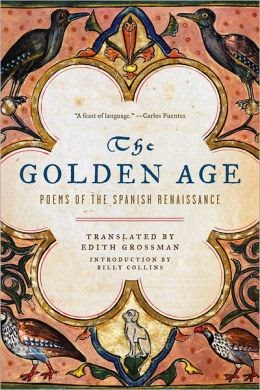
Selected and translated from the Spanish by Edith Grossman
Spain and New Spain, a long time ago...
Jorge Manrique's affecting "Coplas que fizo por la muerte de su padre" [here translated as "Verses Written on the Death of His Father"] (Spain, 1476) doesn't seem like it should be as powerful as it actually is given its metrical simplicity and its apparent lack of verbal pyrotechnics, but it's a poem that did a number on me the first time I read it and a poem that continues to do the same whenever I have the occasion to revisit it. Of course, the ubi sunt thing can always get to you if you're in a susceptible state of mind. And Manrique does have at least one good trick up his sleeve for an elegy. Anyway, to give you an idea of the tenor of the piece and of how Grossman translates the Spanish verse (Grossman: "The meter, called pie quebrado, or broken foot, consists of a fixed alternation of eight- and four-syllable lines in a twelve-line stanza, with a regular rhyme scheme" [1-2]), here's the opening stanza:
Recuerde el alma dormida,
avive el seso y despierte,
contemplando
cómo se passa la vida,
cómo se viene la muerte
tan callando;
cuán presto se va el plazer,
cómo después de acordado
da dolor,
cómo a nuestro parescer,
qualquiera tiempo passado
fué mejor.
Let the dozing soul remember,
let the mind awake and revive
by contemplating
how our life goes by so swiftly
and how our death comes near
so silently;
how quickly pleasure fades,
and how when it is recalled
it gives us pain,
how we always seem to think
that times past must have been better
than today.
As I hope more than just poetry geeks can tell, Grossman's translation flows admirably in modern English even while mimicking Manrique's repetitions. However, one example of the riches that can be lost in translation is that the sixth line that the translator renders as "so silently" is, to my mind, much more powerful in the 15th century Castilian: death is tan callando, or "so silencing," a present participle-aided statement of effect that might not translate as smoothly as "so silently" but which is probably more faithful to the vale of tears sorrow that the poet is seeking to evoke.
Elsewhere, Grossman does a marvelous and maybe even an uncanny job capturing Manrique's mood in English: "Our lives are the rivers/that empty into the sea/that is our dying," from the beginning of the third stanza, is a lovely translation of "Nuestras vidas son los ríos/que van a dar en el mar/que es el morir:" with its tricky third line [literally: "which is dying"], and her close to the ninth stanza's "The agility and speed,/the bodily strength and vigor/of one's youth,/they all turn heavy and dense/when entering the sullen precincts/of old age" is a clear winner even without Manrique's rhyming of "joventud" and "senectud" in the original's "Las mañas y ligereza/y la fuerça corporal/de joventud,/todo se torna graveza/quando llega al arrabal de senectud." As for that trick up Manrique's sleeve that I mentioned at the outset? After using the ubi sunt theme as a prelude to a summary of his father's successes in life (being a friend to friends, an enemy to enemies, and--this being Reconquista Spain--naturally a slayer of Moors), Manrique has Death come knocking at his father's door just long enough to enjoin the caballero to seek eternal life through God rather than the life of this earth, which is fleeting. The last stanza is the one that slays me, but it's a measure of the escalating power of the poem that this stanza, the third from the end, isn't so bad either. The voice belong to Manrique's father:
--"No gastemos tiempo ya
en esta vida mezquina
por tal modo,
que mi voluntad está
conforme con la divina
para todo;
y consiento en mi morir
con voluntad plazentera
clara y pura,
que querer ombre vivir
quando Dios quiere que muera
es locura.
"Now let us spend no more time
on this miserable, this worthless
mortal life,
for in everything my will
conforms with the divine will,
the will of God;
and I consent to my dying
and submit to a desire
bright and pure;
it is madness for a man
to wish to live when God wishes
him to die."
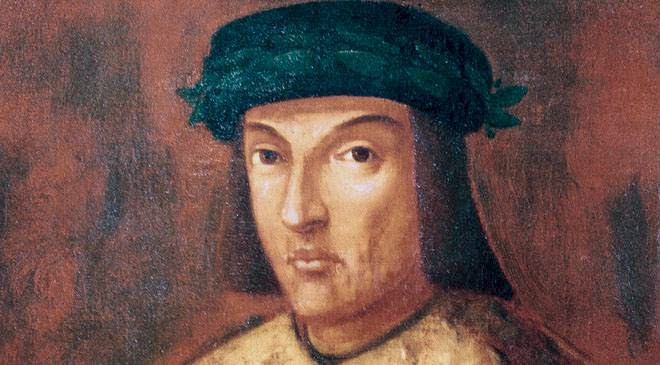
Jorge Manrique (1440-1479)
I hope to write at least two more posts about this collection at some point. In the meantime, please check out the posts below for more on the title. The Manrique poem appears on pp. 1-37.
Amanda, Simpler Pastimes
Scott, seraillon


 Entradas


