Mostrando las entradas con la etiqueta Karl Kraus. Mostrar todas las entradas

domingo, 2 de marzo de 2014

Journalism, Duplicity and the Art of Contrasts

 
"Journalism, Duplicity and the Art of Contrasts"
by Edward Timms
England, 1986

The significance of the emblems which Kraus placed on the cover of Die Fackel in April 1899 will by now be clear.  The mask is the all-pervasive symbol of fin-de-siècle Vienna.  In Kraus's design the grinning mask of comedy and the goatish face of the satyr not only proclaim the intention of comic and satirical stylization.  They also convey an acute awareness of the elements of theatricality and disguise in Austrian affairs.  And the rays emanating from the flaming torch are thrown forward in a pattern that suggests the boards of a stage.  The aim is clearly to break through the clouds of mystification and shed light behind the scenes.  But the configuration of images leaves open the question of the role the editor himself will play in the satirical masquerade.
(Karl Kraus, Apocalyptic Satirist: Culture and Catastrophe in Habsburg Vienna, 29)

The passage above, the closing paragraph from chapter 1 of Karl Kraus, Apocalyptic Satirist, sets the stage so to speak for a shift in focus from the broader panorama of Viennese life c. 1900 to a tight close-up of Kraus's evolving role as an attacker of the Viennese and Austrian media.  Chapter 2, "Journalism, Duplicity and the Art of Contrasts," traces Kraus's transformation from a would-be theater critic to an "increasingly uncompromising" voice intent on attacking "the corrupting influence of the press itself" (35).  What led to Kraus's "increasingly uncompromising" stance?  To help explain things, Timms points to the era as one in which the press achieved "a greater domination over public affairs than in any period before or since" (30) and one in which the Austrian press in particular functioned as either a mouthpiece for the highest bidder or as a front for the state.  "It was the era of the 'newspaper baron' - the owner-editor who had control both of share capital and of editorial policy," he explains.  "Individual owners could exercise almost feudal power over an apparatus whose technological sophistication belonged to the  modern age" (Ibid.).   On the newspapers' collusion with the government, he adds: "The net result of this collaboration was to subvert democratic government, falsify public opinion, and add a further dimension of unreality to Austrian life" (31).  Never shy about pulling a revealing anecdote out of his pocket, the author then illustrates his point with the example of Die Presse founder August Zang, who "is quoted as saying that his ideal would be 'a newspaper that did not contain a single line that had not been paid for'" and mentioning the fact that "the device of printing advertisements disguised as news items was accepted journalistic practice" (32).  As an explanation more concerned with matters of style than the duplicity of the newspapers themselves, Timms also explains the influence of satirical forerunners Ferdinand Kürnberger and Daniel Spitzer as models for the early Kraus.  According to Timms, the former, who memorably retorted to readers who complained that he was injecting too much politics into their arts section by asking, "Am I writing about politics?  [...]  I am writing the theatre review of the Austrian tragedy" (33, love it!), eventually wins out over the latter as a more suitable role model for Kraus given the increasingly violent and unstable atmosphere near the end of the 1890s.  Ever insightful about his subject, though, Timms takes this opportunity to make what I think is a terrific, nuanced observation: "The contrast between Kürnberger and Spitzer defines a polarity that runs through the work of Kraus himself - the tension between vigorous polemical commitment and self-absorbed verbal artistry" (34).

Moving on from Kraus's influences to his early work in Die Fackel, Timms then explains how the future apocalyptic satirist was able to maintain an "independent voice" (35) in such a turbulent atmosphere for the press: Kraus's father covered the publication costs of the first issue of Die Fackel, and its status as an instant hit made it financially self-sustaining afterward.  Ironically, while not above making disparaging comments about the "tip-receiving classes" (34), Kraus's own personal economic well-being and privilege resulted in a journal which was "explicitly reformist" despite its "polemical vitality and wit" during the first five years or so of its run.  As Timms stresses, Kraus's aim at this point was "amendment, not entertainment" (36-37).  Why is this an important distinction?  First, Kraus's "mission as a satirist was to attack ideological thinking in all its forms, not merely those he happened to personally dislike" (37).  Second, it explains another "paradox which runs right through Kraus's writings.  As a reformist critic he certainly wished to raise the standards of Austrian journalism; but as satirist he proclaims that the press is irredeemably corrupt" (41).  If I understand the ensuing argument correctly, Kraus's recognition of this "paradox" eventually resulted in a renunciation of such reformist tendencies in favor of a more pure polemical outlook as time went on.  But in the early days at least, the future crank was almost an optimist: Timms claims that Kraus "wanted to teach people to read - to read the public prints with scepticism and mistrust" and that he even seemed "to entertain the hope that a revival of civilization as a whole might be achieved through the growth of critical enlightenment."  The enemy?  In Kraus's marvelous phrasing, "a civilization corroded by printer's ink" (41)!

For those who have read Kraus before and who are maybe wondering along with me how much of his vituperative brilliance was due to artistic purity and how much was due to him just being a bit of a nutjob, Timms has some extremely interesting things to say about the satirist's personality or predispositions--in particular about Kraus's apparently heightened sensitivity to masks and other forms of duplicity.  "Kraus's whole mode of perception seems to have been shaped by a sensitivity to masks and disguises," he writes, a "subjective factor" (44) that helps explain the motif of the mask as "a unifying principle underlying [Kraus's] writings" when those same writings are "so diverse" in themes in the early years of Die Fackel that its readers may well be left "with an impression of fragmentation and incoherence" (42).  To explain this, Timms zeroes in on the fact that "it is not simple inhumanity, it is the more complex phenomenon of duplicity that Kraus attacks" in a series of articles on a coal miners strike (Ibid.).  Beyond that, "it is this seminal image of the mask which gives a structural coherence to Kraus's early writings, particularly to his critique of the press.  What he attacks most forcefully is not its financial corruptness, but the discrepancy between its shady financial dealings and its resplendent cultural prestige."  Or, as Kraus puts it, "the press is a prostitute which in Austria wears the robes of a priestess" (Ibid.).  According to Timms, for Kraus, "this theme of duplicity finds its most intense focus in the problem of Jewish identity...  The Jews of Vienna found themselves caught between two cultures: the traditional Judaic community and modern secular society.  This was made embarrassingly evident by the fact that many Jews had two different names" because "a decree signed by Joseph II in 1787 had imposed German surnames on Austrian Jews" (43, ellipses added).  The upshot of all this as it pertains to the Die Fackel firebrand?  "For Kraus," himself an assimilation-minded Jew apparently troubled by both antisemitism and Zionism, "these assimilated names were a disguise.  When Felix Salten tries to establish himself as authentically Viennese, readers of Die Fackel are reminded that behind that aristocratic-sounding name there lurks an immigrant from Budapest called Zsiga  Salzmann."  Ouch!  "Indeed, there were so many Samuels masquerading as Siegfrieds that Kraus could with some justice speak of a 'pseudonymous civilization'" (Ibid.).  With a young Adolf Hitler waiting in the wings of this "polyglot Empire," it's no surprise that Timms points to the "rich" but "problematic" nature of Kraus's "satire on the duplicity of names"--while stopping just short of calling Kraus out for hypocrisy (Ibid.).  However, I like where he takes it from there in terms of the satirist's work as whole.  Kraus, supposedly "wavering between what he calls 'social' satire and a more 'literary' style that would be modeled on the work of earlier authors," in October 1907 describes his métier as follows: "I am a satirist, and my gaze is caught by contrasts.  What matters is not what I think about the Austro-Hungarian Compromise, but what I think about the type of person who ought to be thinking about the compromise" (44-45).  Timms, explaining the importance of "Kraus's preoccupation with duplicity" as something that "provides a structural explanation for what appears to be an ideological bias," gets the last word here in response: "At times Kraus's sensitivity to disguises obstructs his perception of the historical balance of forces.  And it certainly impairs his political judgement.  But for one task it left him admirably equipped: for the writing of satire and polemic.  It is here that his antithetical sensibility comes into its own.  For satire is the art of contrasts" (45-46).


"Journalism, Duplicity and the Art of Contrasts," chapter 2 in Edward Timms's Karl Kraus, Apocalyptic Satirist: Culture and Catastrophe in Habsburg Vienna, appears on pp. 30-46 of the work (New Haven and London: Yale University Press, 1986).  Chapter 1, "Vienna 1900," is recapped here.

miércoles, 26 de febrero de 2014

Vienna 1900

"Vienna 1900"
by Edward Timms
England, 1986

If the rest of Karl Kraus, Apocalyptic Satirist: Culture and Catastrophe in Habsburg Vienna (Yale University Press, 1986) is even half as rewarding as its first chapter, I'll have to buy the book instead of just keeping it out on semi-permanent loan from the library.  That'd make it much, much easier for me to get through the following 21 posts on Kraus that I know you'll be eagerly waiting for before I take on Timms's 2005 follow-up.  In the meantime, let's take a closer look at "Vienna 1900."  Timms, Research Professor and Director of the Centre of German Studies at the University of Sussex according to Wikipedia, gets things off to a fine start by pointing out that "the silhouette of Vienna, darkly illuminated on the cover of Die Fackel, marks out the horizon of Kraus's world...  It was here that he wrote, edited and published the 922 numbers of Die Fackel which contain his life's work" (3, ellipses added).  What's so fine about that?  The answer comes in the following paragraph where Timms explains that "this lifelong attachment to the city he reviled is one of the paradoxes of Kraus's career.  It also defines the nature of his achievement.  It is not the great world of European politics but the local affairs of Vienna that provide his theme...  Even when his theme is the breakdown of western civilization, it is still in the Kärntnerstrasse that he finds the motifs for his satire" (Ibid., ellipses added).

After declaring that Kraus's "passionate parochialism" is one of "the primary fascination[s]" of his writings (Ibid.), Timms turns his sights on fin-de-siècle Vienna to explain why the city and the satirist who reviled it were so well suited to each other.  In between three separate anecdotes about Kraus either being assaulted by different victims of his satire or having to call the police to stop his first play from being "wrecked by enraged spectators" (6), Timms sketches a portrait of Vienna in which an audience particularly receptive to satire, a lively literary coffeehouse culture in which various intellectual circles intermingled, and tensions between the city's avant-garde and conservative cultural factions all uneasily coexisted: "Conflict rather than conciliation was the keynote," we are told, "not only for Kraus but for his whole generation of Austrian iconoclasts" (Ibid.).  According to his biographer, Kraus's circle, which met at a place called the Café Central, "was at the centre of the system" based on its "decisive influence" on the other groups (9).  This leads us to two Walter Benjamin-like telling insights about Kraus the man which help us better understand Kraus the writer (both also from page 9): 1) "Although he adopts in Die Fackel a stance of embattled isolation, he was in truth a convivial person who by 1910 had gathered around him an amazingly gifted circle of writers and artists"; 2) "His position is paradoxically poised between the exclusivity of this élite and the appeal of Die Fackel to a wider audience.  In insistent declarations he claims for his writings an artistic autonomy which transcends the mundane concerns of his readers.  But if he was writing his magazine for posterity, he was selling it to his contemporaries."  Selling it indeed: the first issue of Die Fackel sold nearly 30,000 copies!

For somebody with only the most rudimentary grasp on the history of the Austro-Hungarian Empire (Q: Who was Franz Ferdinand?  A: The name of both the assassinated archduke and that of a crappy Scottish rock band), I was happy to see Timms spend some time contextualizing Vienna's role within the empire next.  Citing Kraus's 1914 "prophetic phrase" that Austria-Hungary was and would remain an "experimental station for the end of the world" (10), Timms fast forwards through several decades of history to make the case that the Habsburg state, riven by rapid population growth, antisemitism, and the difficulty of maintaining unity in a land recognizing fifteen official languages among other stresses, was "essentially medieval in character" (12).  The architect Adolf Loos, a Kraus ally whose "threateningly modernist building on the Michaelerplatz" provoked Vienna's City Council into taking out an "injunction" against it in protest (6), is elsewhere reported as remarking that "while he was living in the year 1908 his neighbour was living in 1880, while there were peasants in the Austrian provinces still living in the twelfth century" (19).   Although I won't go into all the details since they're too complex to summarize in a limited amount of time, here are two good thumbnails of Timms's writing style and critical acumen.  The first has to do with the main capital (Budapest was the site of the other capital):  "The unified city culture was essentially a myth, concocted by writers encapsulated in their coffee-houses.  The reality of working-class experience hardly impinged on their pages, although it is clearly enough recorded in the memoirs of less privileged contemporaries.  Kraus, like other members of the intellectual élite, had no contact with the cultural aspirations of the working class, until he swung his support behind the socialist cause after the collapse of the Empire" (16).  The second has to do with the nation: "Since the two decisive intellectual movements of modern Europe--the Reformation  and the Enlightenment--had left the Habsburg Empire intact, a multinational state based on anachronistic principles survived into a century which was fundamentally hostile to them" (12).  The importance of this decline in regard to Kraus's writing?  According to the critic, "Kraus's satire is the expression of a civilization inwardly disintegrating."  Mentioning the high suicide rate in the Austrian army and among intellectuals, he adds: "It is hardly surprising that in Kraus's writings (as we shall see) suicide becomes a recurrent symbolic motif" (18).  Perhaps that's a good place to pause for now.

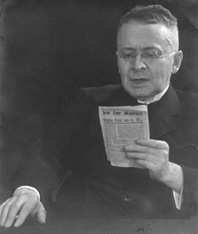
Professor Edward Timms

"Vienna 1900" is the first of three chapters from Part One (City, Masks and Torch) of Edward Timms's Karl Kraus, Apocalyptic Satirist: Culture and Catastrophe in Habsburg Vienna (New Haven and London: Yale University Press, 1986, 3-29).  A teaser for the rest of the work: "The spheres of activity on which this book focuses - journalism, the theatre, prostitution and the enforcement of morals, theories of the unconscious, architectural design, advertising, technology, the problems of language, and the role of the artist - are only apparently 'unpolitical'.  Each of these spheres contributed to the masquerade of Austrian public life, which reached its climax during the First World War in the 'Tragic Carnival'" (28).

miércoles, 15 de mayo de 2013

Karl Kraus 3. Monster [Unmensch]

"Karl Kraus"
by Walter Benjamin [translated from the German by Edmund Jephcott]
Germany, 1931

"Monster [Unmensch]," to my mind the least linguistically explosive of the three sub-sections in Benjamin's study on Karl Kraus although of course only relatively speaking at that, still begins with a typical Benjamin bombshell in which he compares "the genuine satirist" Kraus with "the scribblers who make a trade of mockery and who, in their invectives, have little more in mind than giving the public something to laugh about" (378).  What makes a true satirist like Kraus stand out from this pack of lightweight jokers?

In contrast, the great type of the satirist never had firmer ground under his feet than amid a generation about to mount tanks and put on gas masks, a mankind that has run out of tears but not of laughter.  In him civilization prepares to survive, if it must, and communicates with him in the true mystery of satire, which consists in the devouring of the adversary.  The satirist is the figure in whom the cannibal was received into civilization.  His recollection of his origin is not without filial piety, so that the proposal to eat people has become an essential constituent of his inspiration, from Jonathan Swift's pertinent project concerning the use of the children of the less wealthy classes, to Léon Bloy's suggestion that landlords of insolvent lodgers be conceded a right to the sale of the lodgers' flesh.  In such directives, great satirists have taken the measure of the humanity of their fellow men.  "Humanity, culture, and freedom are precious things that cannot be bought dearly enough with blood, understanding, and human dignity"--thus Kraus concludes the dispute between the cannibal and human rights.  One should compare his formulation with Marx's treatment of the "Jewish question," in order to judge how totally this playful reaction of 1909--the reaction against the classical ideal of humanity--was likely to become a confession of materialist humanism at the first opportunity.  Admittedly, one would need to understand Die Fackel from the first number on, literally word for word, to predict that this aesthetically oriented journalism, without sacrificing or gaining a single motif, was destined to become the political prose of 1930.  For this it had to thank its partner, the press, which disposed of humanity in the way to which Kraus alludes in these words: "Human rights are the fragile toy that grownups like to trample on and so will not give up" (ibid.).
 
From this beginning on genre matters, Benjamin traces the satirist's career arc through operettas (Benjamin: "Just as prattle seals the enslavement of language through stupidity, so operetta transfigures stupidity through music" [379]), through his public readings, through his "hate poems" (383) and finally back to his polemics--all making me wish I knew more about Kraus than I do.  Perhaps Benjamin felt the same for, despite a poetic summation at the end in which he seeks to portray the protean "monster" Kraus as the archetypal angel of "a humanity that proves itself by destruction" (387), it's this earlier quote on our corrosive hero's "combative aspect" that ironically feels like the most revealing R.I.P. to me: "No one can grasp the necessity that compelled this great bourgeois character to become a comedian, this guardian of Goethean linguistic values a polemicist, or why this irreproachably honest man went berserk" (386).

Source
As previously noted, "Karl Kraus" appears on pp. 361-390 of the Walter Benjamin anthology, The Work of Art in the Age of Its Technological Reproducibility and Other Writings on Media, edited by Michael W. Jennings, Brigid Doherty, and Thomas Y. Levin (Cambridge & London: The Belknap Press of Harvard University Press, 2008).

martes, 14 de mayo de 2013

Karl Kraus 2. Demon

"Karl Kraus"
by Walter Benjamin [translated from the German by Edmund Jephcott]
Germany, 1931

As quotable as Benjamin is throughout his wide-ranging essay on Kraus, it's in the middle section, "Demon," where you really begin to appreciate his profundity and his artistry as a critic.  Benjamin doesn't see Kraus as a polemicist who is drawn to pontificating about evil in order to perform some greater good for the rest of us.  In fact, he scoffs at the idea of Kraus as an "ethical personality" at all: "The dark background from which Kraus's image detaches itself," Benjamin writes, "is not formed by his contemporaries, but is the primeval world [Vorwelt], or the world of the demon" (370).  Kraus' vanity, "his unconquerable need to be perceived" is undeniable according to the critic.  But to what end?  Benjamin sees it as arising from a complex interplay of "self-expression" and "self-unmasking" in which, perhaps unwittingly at times, Kraus offers up his own life as a performative "sacrifice to his vanity" (370-371).  Benjamin: "Idiosyncrasy as the highest critical organ--this is the hidden logic of that self reflection and the hellish state known only to a writer for whom every act of gratification becomes at the same time a station of his martyrdom, a state experienced, apart from Kraus, by no one as deeply as by Kierkegaard."  Kraus, quoted by Benjamin: "I am perhaps the first instance of a writer who simultaneously writes and experiences his writing theatrically" (371).

Kraus' "mimetic genius, imitating while it glosses, pulling faces in the midst of polemics," inspires some of Benjamin's finest, most penetrating writing about "the demon in the man" that is Kraus (371).  You don't, I hope you'll agree, even need to know anything about Kraus to appreciate an arresting description like this:

[Kraus] imitates his subjects in order to insert the crowbar of his hate into the finest joints of their posture.  This quibbler, probing between syllables, digs out the larvae that nest there in clumps.  The larvae of venality and garrulity, ignominy and bonhomie, childishness and covetousness, gluttony and dishonesty.  Indeed, the exposure of inauthenticity--more difficult than that of the merely bad--is here performed behavioristically.  The quotations in Die Fackel are more than documentary proof: they are the props with which the quoter unmasks himself mimetically.  Admittedly, what emerges in just this connection is how closely the cruelty of the satirist is linked to the ambiguous modesty of the interpreter, which in his public readings is heightened beyond comprehension.  "To creep"--this is the term used, not without cause, for the lowest kind of flattery; and Kraus creeps into those he impersonates, in order to annihilate them.  Has courtesy here become the mimicry of hate, hate the mimicry of courtesy?  However that may be, both have attained perfection, absolute pitch.  "Torment," of which there is so much talk in Kraus in such opaque allusions, here has its seat.  His protests against letters, printed matter, documents are nothing but the defensive reaction of a man who is himself implicated.  But what implicates him so deeply is more than deeds and misdeeds; it is the language of his fellow men.  His passion for imitating them is at the same time the expression of and the struggle against this implication, and also the cause and the result of that ever-watchful guilty conscience in which alone the demon is his element (371-372).

It would be easy enough to stop at this point given how much Benjamin has already shed light on the slippery Kraus, but he isn't done trashing the explanations of the Kraus fans who posit "compassion" as one of the hidden wellsprings of the Austrian's art:

No!  This incorruptible, piercing, resolute assurance does not spring from the noble poetic or humane disposition that his followers are so fond of attributing to him.  How utterly banal, and at the same time how fundamentally wrong, is their derivation of his hatred from love, when it is obvious how much more elemental are the forces here at work: a humanity that is only an alternation of malice and sophistry, sophistry and malice, a nature that is the highest school of aversion to mankind and a pity that is alive only when interlaced with vengeance (372).

Is Benjamin's a partisan study?  You be the judge.  Citing Brecht's great quote about Kraus, "When the age laid hands upon itself, he was the hands" (372), Benjamin then moves on from Kraus' primal desire for vengeance to his apocalyptic vision of justice.  Whatever you make of the argument, the language itself is impeccable, insistent: "Nothing is understood about this man until it has been perceived that, of necessity and without exception, everything--language and fact--falls, for him, within the sphere of justice.  All his fire-eating, sword-swallowing philology in the newspapers pursues justice just as much as language" (373).  But where does this sense of justice originate from other than from within the demon himself?  One of Benjamin's answers may surprise you for it's none other than Baudelaire whom he sees as one of Kraus' spiritual ancestors:

Only Baudelaire hated, as Kraus did, the satiety of healthy common sense, and the compromise that intellectuals made with it in order to find shelter in journalism.  Journalism is betrayal of the literary life, of mind, of the demon.  Idle chatter is its true substance, and every feuilleton poses anew the insoluble question of the relationship between the forces of stupidity and malice, whose expression is gossip.  It is, fundamentally, on the complete agreement of two forms of existence--life under the aegis of mere mind, and life under the aegis of mere sexuality--that the solidarity of the man of letters with the whore is founded, a solidarity to which Baudelaire's existence is once again the most inviolable testimony (376).

Benjamin concludes this part of his work with a somewhat complicated--and perhaps not altogether convincing--argument linking Kraus' hatred of the press with his defense of prostitution, the commoditization of words and the commoditization of the flesh (a Kraus flashback: "Penury can turn every man into a journalist, but not every woman into a prostitute" [375]).  Although I'm not sure I buy all of it, I have to admit that Benjamin's musings on sexuality and the mind as it possibly pertains to Kraus did permit one final sneak attack that sort of waylaid me.  The subject?  An evocation of Kraus' nights which, perhaps on account of its lack of romanticism about the tortured artist, speaks to me more than it otherwise should:  "His night, however, is not a maternal night, or a moonlit, romantic night: it is the hour between sleeping and waking, the night watch, the centerpiece of his threefold solitude: that of the coffeehouse, where he is alone with his enemy; of the nocturnal room, where he is alone with his demon; of the lecture hall, where he is alone with his work" (377).

Source
"Karl Kraus."  In Walter Benjamin, The Work of Art in the Age of Its Technological Reproducibility and Other Writings on Media, edited by Michael W. Jennings, Brigid Doherty, and Thomas Y. Levin (Cambridge & London: The Belknap Press of Harvard University Press, 2008, 361-390).

lunes, 13 de mayo de 2013

Karl Kraus 1. Cosmic Man [Allmensch]

"Karl Kraus"
by Walter Benjamin [translated from the German by Edmund Jephcott]
Germany, 1931

Walter Benjamin's 1931 essay on Karl Kraus and his Viennese newspaper Die Fackel, conveniently divided into the sections "1. Cosmic Man [Allmensch]," "2. Demon" and "3. Monster [Unmensch]" and all introduced by a Kraus epigraph, is almost as much fun to read as Kraus himself.  Although I hope to return to the second and third parts of the essay later in the week (the thing's just too rich to try and cover in one post), here's the German critic's attention-grabbing beginning:

In old engravings, there is a messenger who rushes toward us crying aloud, his hair on end, brandishing a sheet of paper in his hands--a sheet full of war and pestilence, of cries of murder and pain, of danger from fire and flood--spreading everywhere the Latest News.  "News" in this sense, in the sense that the word has in Shakespeare, is disseminated by Die Fackel [The Torch].  Full of betrayal, earthquakes, poison, and fire from the mundus intelligibilis.  The hatred with which it pursues the tribe of journalists that swarms into infinity is not only a moral hatred but a vital one, such as is hurled by an ancestor upon a race of degenerate and dwarfish rascals that has sprung from his seed.  The very term "public opinion" outrages Kraus (361).
 
While you'd think it'd be hard to maintain the intensity level of that opening, Benjamin shifts from this "visual" introduction of Kraus to a descriptive appraisal of Kraus' motivations without any appreciable loss of adrenaline.  After calmly stating that the empty phrase is Kraus' enemy, "the unmasking of the inauthentic" is the source of his hatred of the press (362-363), Benjamin launches into a feverish appreciation of Die Fackel's role in the combat:
 
The intertwining of biblical magniloquence with stiff-necked fixation on the indecencies of Viennese life--this is its way of approaching phenomena.  It is not content to call on the world as witness to the misdemeanors of a cashier; it must summon the dead from their graves.  --Rightly so.  For the shabby, obtrusive abundance of these scandals in Viennese coffeehouses, the press, and society is only a minor manifestation of a foreknowledge that  then, more swiftly than anyone could perceive, suddenly arrived at its true and original subject: two months after the outbreak of war, Kraus called this subject by name in his speech "In These Great Times," with which all the demons that inhabited this possessed man passed into the herd of swine who were his contemporaries (363-364).
 
Although I'd already want to read more about Kraus (and read more by Benjamin) from that last line of Benjamin's alone, the essayist inserts a head-spinning excerpt from "In These Great Times" (the mercurial Kraus: "Let him who has something to say step forward and be silent!") before adding:
 
Everything Kraus wrote is like that: a silence turned inside out, a silence that catches the storm of events in its black folds and billows, its livid lining turned outward...the polemical possibilities of every situation are totally exhausted.  With what precautions this is surrounded can be seen from the barbed wire of editorial pronouncements that encircles each edition of Die Fackel, as from the razor-sharp definitions and provisos in the programs and lectures accompanying his readings from his own work.  The trinity of silence, knowledge and alertness constitutes the figure of Kraus the polemicist (364-365, ellipses added).
 
Those of you who know how Kraus ended his career will understand why Benjamin was startlingly prescient about the Austrian polemicist here.  Those of you who know how Benjamin ended his career may well wonder whether the writing was already on the wall for both of these men.
 
Source
"Karl Kraus" appears on pp. 361-390 of the Walter Benjamin anthology, The Work of Art in the Age of Its Technological Reproducibility and Other Writings on Media, edited by Michael W. Jennings, Brigid Doherty, and Thomas Y. Levin (Cambridge & London: The Belknap Press of Harvard University Press, 2008).  Walter Benjamin photo above: photographer unknown.

sábado, 4 de mayo de 2013

Self-Admiration

"Self-Admiration"
by Karl Kraus [translated from the German by Helene Scher]
Austria, 1908

Since Tom from Wuthering Expectations has already sufficiently immortalized both Kraus' caustic aphorisms and his only half-translated but yet doubly apocalyptic play The Last Days of Mankind, I'd like to exit stage right from my formal participation in Karl Kraus Week with a quick look at Kraus' delirious self-encomium innocuously titled "Self-Admiration."  Before we begin, though, I should probably admit that one of the questions that's been increasingly nagging me during my 33-page introduction to the Austrian wiseass this week--although one that I've been more or less assiduously avoiding anyway--is trying to determine where the slippery satirist ends and where the full-on real life nutjob begins.  Is such a thing even possible to pinpoint?  In his introduction to the Kraus et al. anthology that I've been using, Dirck Linck, while not exactly answering my question, at least gives me the comfort of knowing that even sage specialists have taken late Kraus' literary aims seriously within their particular regional and temporal contexts: "What Kraus, Broch, and Canetti present in their works is a symptomatology of the epochal violence that was clearing the ground for the terrors of National Socialism.  It is no coincidence, therefore, that both Broch and Canetti backed up their literary works with significant theoretical reflections on mass psychology, jurisprudence, and politics, all aimed at the totalitarian disposition of the century" (x).  "Self-Admiration," it will soon become clear, is an apolitical early work that has nothing to do with "the totalitarian disposition of the century" or anything like that although I do like the sound of the description enough to repeat it.  That being said, can the five-page essay get us any closer to identifying where the artist ends and the con artist begins when it comes to Kraus' idiosyncratic aesthetic disposition?  Ridiculously, I'm not really sure!  Kraus begins his lively but problematic essay with two epigraphs, one from Schopenhauer and one--devilishly--from Kraus himself.  The latter: "Self-admiration is permissible if the self is beautiful.  It becomes an obligation if the reflecting mirror is a good one."  Before the laughter has died down, Kraus assails the reader with yet another back-patting brick through the window in his opening sentence: "That I accept the reproach of self-admiration as the observation of a character trait well known to me and that I respond, not with contrition, but by continuing the provocation--this my readers should know by now" (19).  In what follows, Kraus makes the argument--ironic perhaps but just how ironic?--that it's not wrong for him to be arrogant or vain given his talent level.  "Viennese intellectuals ought to be grateful to me for having taken the trouble off their shoulders and preserved their reputation" he writes.  "Whoever gladly dispenses with praise from the multitude, will not deny himself the chance to be his own partisan" he adds (ibid.).  Lambasting the Viennese critics who "are hiding their respect for me, which grows greater by the day, behind the cowardly mask of convention," Kraus then drops two tasty autobiographical tidbits about how he and his one-man newspaper were apparently perceived by some in his early 20th century audience, claiming that "I am considered to be merely a watchdog for the corrupt machinations of a city" in one paragraph and that he is "an author who publishes his diary as a periodical" in another (20).  If it's hard to know how much Kraus was joking at this remove in time, perhaps the question doesn't really matter all that much anyway.  For it's hard not to like a writer who can conceive of his oeuvre as a diary and who will defend himself from the accusation from "riffraff" that "my preoccupation with myself, my position, my books, and my enemies" takes up half his "literary activity" when he himself readily admits, "it takes up all of my literary activity" (23).  I, for one, am sorry that Karl Kraus Week has come to a close.

Source
Thanks again to Tom for inciting me to read the irrepressible crackpot Karl Kraus as part of Wuthering Expectations' The Austrian Literature Non-Challenge.  Tom's final post this week,  "Kraus the prophet - Don't ask why all this time I never spoke," pays a fitting tribute to Kraus' complexity with some melancholy reflections on what finally silenced "one of the few true satirists." "Self-Admiration" can be found on pages 19-23 of Dirck Linck, ed., Selected Short Writings: Karl Kraus, Hermann Broch, Elias Canetti, Robert Walser (New York & London: Continuum, 2006).  Kraus: "The world considers it more important for someone not to regard his work as great than that it be great."  Goethe, as quoted by Kraus: "Only good-for-nothings are modest" (22-23).

miércoles, 1 de mayo de 2013

Tourist Trips to Hell

"Tourist Trips to Hell"
by Karl Kraus [translated from the German by Frederick Ungar]
Austria, 1920

"I didn't ask for sunshine, and I got World War III."
Sex Pistols, "Holidays in the Sun"

If "The Cross of Honor," a homily on some of the idiocies of Austrian prostitution laws c. 1909, was a good example of a rather frisky and witty Karl Kraus, the later "Tourist Trips to Hell" is an excellent example of an altogether different Herr Kraus: angry, indignant, denunciatory...punk?  Our hero, you see, wasn't much of a fan of World War I nor of the motley collection of culture-less entities variously gathered under the rubric of mankind.  Two out of two ain't bad, eh?  "I have in my hands a document that surpasses and seals the shame of this age, and would warrant assigning a place of honor in a cosmic boneyard to this money-hungry mess that calls itself mankind.  If ever a newspaper clipping meant a clipping of creation--here we face the utter certainty that a generation to which such solicitations could be directed no longer has any better instincts to be violated" (4).  The newspaper clipping in question, a two-page spread from the Basel, Switzerland rag Basler Nachrichten pimping "BATTLEFIELD EXCURSION TRIPS BY CAR!" in oversized type to woo just-post WWI vacationers to visit the battlefield at Verdun in order to understand "the quintessence of the horror of modern warfare" in between guided tours and sumptuous dining "with ample meals at first-rate restaurants" for the all-inclusive price of 117 Swiss francs (6-7), is an outrage that prompts Kraus to mock it in ad-like bullet points by comparing it to a sort of media version of Verdun in which "this most gruesome spectacle of bloody delirium through which the nations let themselves be dragged to no purpose whatsoever" pales in comparison with the "enormity" of the offending ad (4).  Overkill?  Not the way Kraus sings it, anticipating the Sex Pistols' formulation of "a cheap holiday in other people's misery" only sans jackboots and power chords. In any event, the following bullet points, all lifted from pages 5 and 8 of Kraus' broadside, will allow you to decide for yourself what a tourist trip to hell might look like:
  • You receive a newspaper in the morning.
  • You will learn that 1,500,000 bled to death exactly at the spot where wine and coffee--and everything else--are included.
  • You understand that all this came about so that some day, when nothing was left of the glory except moral bankruptcy, at least a battlefield par excellence would still be available.
  • You realize that what the competition can offer--the Argonne and Somme battles, the boneyards of Rheims and St. Mihiel--is a mere trifle compared with the first-class offering of the Basler Nachrichten.  They will doubtless succeed to fatten their list of subscribers using the casualties of Verdun.
  • You realize that these nations have criminal laws to protect the life and even the honor of these press scoundrels who make a mockery of death and a profit out of catastrophe, and who particularly recommend this side trip to hell as an autumn special.
  • You will have unforgettable impressions of a world in which there is no single square centimeter not rutted by shells and advertisements.
  • And if, even then, you have not recognized that your very birth has brought you into a murderers' pit and that a mankind which profanes even the blood it shed is shot through and through with evil, and that there is no escaping it and no help--then the devil take you to a battlefield par excellence!
Source
"Tourist Trips to Hell," "reviewed" for Tom's Karl Kraus week, appears on pages 4-8 of editor Dirck Linck's Selected Short Writings: Karl Kraus, Hermann Broch, Elias Canetti, Robert Walser (New York & London: Continuum, 2006).  Tom's own latest writings on Kraus can be read about here and here.

lunes, 29 de abril de 2013

The Cross of Honor

"The Cross of Honor"
by Karl Kraus [translated from the German by Frederick Ungar]
Austria, 1909

Karl Kraus, the apparent John the Baptist to Thomas Bernhard's Jesus as far as malcontent Austrian insult artists go--although unfortunately I still have to cast the role of Judas, here turns in a winning (and mostly insult-free) two and a half page production on prostitution that's sure to delight a certain type of reader.  Might you yourself qualify as that certain type of reader?  Let's put our Memento-style recap machine to the test to find out.  "For justice is a whore that will not be gypped and exacts the wages of shame even from the poor!" Kraus thunders at the end, the only "logical" conclusion to a generally pro-prostitute "social criticism" tirade in which he takes Austrian lawmakers and law enforcers to task for their bureaucratic inanities and hypocrisy regarding the regulation of the trade in the flesh.  In the anecdotal middle section of his essay, Kraus slips in a humorous tidbit about "a daughter of joy" whose parading about a brothel while wearing the military cross of honor of the title caused her unforeseen legal problems for arousing indignation rather than arousal among her civic-minded clientele.  Tsk, tsk.  Finally, for the morality police and the criminal taxonomists in our midst, there is this somewhat, ahem, anticlimactic beginning: "In Austria there is a graduated scale of culpability for young girls who embrace a life of vice.  A distinction is made between girls who are guilty of engaging in prostitution without authorization, girls who falsely declare that they are under the supervision of the police morals division and, finally, girls who are licensed to practice prostitution but not to wear a cross of honor.  This classification is confusing at first sight, yet it is in complete accord with the facts of the situation."  With this opening, Kraus rests his case--as do I.

Source
"The Cross of Honor," apparently a newspaper piece from the frisky Kraus, appears on pages 1-3 of the Dirck Linck-edited Selected Short Writings: Karl Kraus, Hermann Broch, Elias Canetti, Robert Walser a/k/a The German Library: Volume 56 (New York & London: Continuum, 2006).  The Portrait of Karl Kraus, above, is a 1925 work by Oskar Kokoschka.  More on "the angry Austrian satirist Karl Kraus" over at Tom's Wuthering Expectations blog sometime soon and probably here later in the week in between the Gogol and Platonov posts I owe some of you.