sábado, 12 de julio de 2014

La asesina ilustrada

La asesina ilustrada (Tusquets Editor, 1977)
by Enrique Vila-Matas
Spain, 1977

I have good news and bad news for you Spanish Lit Month yobbos tonight.  The good news is that the previous Vila-Matas that I read, 1985's devilishly entertaining Historia abreviada de la literatura portátil, is finally going to be translated into English next year just in time for its 30th anniversary.  The bad news is that the most recent Vila-Matas that I read, 1977's disappointing La asesina ilustrada, well, let's just say that it really isn't all that entertaining at all.  Now a book about a manuscript that kills is a killer idea to be sure--especially one blessed with such an inspired title as La asesina ilustrada, which can be rendered as either The Illustrated Assassin or The Well Read Killer or even The Killer Made Famous,* three descriptions which fit the villainous title text to a t--but unfortunately this sophomore effort from the young Vila-Matas is rather plodding in its attempts to cobble together a death-by-writing spin on the locked room mystery and entirely lacking in all the biting wit and genre-bending storytelling savoir-faire to be found in later works by the author.  As proof of the 88-page novella's soporific qualities, I have absolutely zero quotes from La asesina ilustrada to share for which I apologize in the timeless words of an actual memorable villain from non-Spanish Lit Month days gone by: "Youths!  I invoke your sympathy.  Maidens!  I claim your tears."

*[Edit: Thanks to JacquiWine and Stu for informing me that La asesina ilustrada has been rendered into English as The Lettered Assassin in the translation of EV-M's Never Any End to Paris: a much better choice than any of the "creative" ones I submitted above!]

Enrique Vila-Matas

lunes, 7 de julio de 2014

La ciudad de las ratas

La ciudad de las ratas [La Cité des rats] (El cuenco de plata, 2009)
by Copi [translated from the French by Guadalupe Marando, Eduardo Muslip & María Silva]
France, 1979

As far as rodent/human epistolary novels set in the City of Light go, La ciudad de las ratas [original title: La Cité des rats; English approximation: City of Rats] is probably in a league of its own.  Probably?  Literally!  Prologuist and co-translator Eduardo Muslip conveniently enough for me describes the work as "una mezcla de relato de aventuras, fábula rabelaisiana y novela experimental" ["a mix of adventure tale, Rabelaisian fable and experimental novel"] (5), to which I'd only add that its gross out humor and sheer wrongness are comparable in sicko comedic verve and scale to the night I saw Pink Flamingos at a midnight screening in the early '80s only to find entire rows of people walking out on the flick at staggered intervals.  Quite an impression!  Quite a parallel!  Narrated by the likeable sewer rat Gouri in conjunction with his human friend and the purported translator of the tale Copi, La ciudad de las ratas spins a wild, orgiastic tale--again, literally!--in which the struggle for the rat nation to survive amid a cosmic struggle involving the Dios de los Hombres [God of Mankind] and the Diablo de las Ratas [Devil of the Rats] leads to an all too human situation in which the Île de la Cité with Notre-Dame de Paris intact splits off from its European moorings and drifts to the New World with the U.S. and Russian navies in hot pursuit.  A foundational tale of a sort.  Although things end on a somewhat apocalyptic note beyond the mere smashing of the stained glass windows at the Sainte-Chapelle and the destruction by fire of the Académie française and the Louvre as you might imagine if you're at all familiar with Copi's earlier Enrique Vila-Matas translated "El uruguayo"/"L'Uruguayen," I won't say anything more about the vachement violent ending since I don't want Fnac to lose any sales over a careless abuse of the spoiler alert function on my keyboard.  That being said, here are three things I thought were really cool about the novel even though I probably could have done without occasional provocations like the "comedic" necrophilia scene near the end: 1) In a novel in which absurdism and realism reign side by side in monarchical harmony (or something) and in a novel in which some of the star sidekicks of Gouri and his rat friend Rakä so to speak include characters known as la Reina de las Ratas [the Queen of Rats] and el Emir de los Loros [the Emir of the Parrots], I for some reason couldn't stop laughing at two strategically placed words from the otherwise nondescript line "Todos los demás, hámsters incluidos, me gritaban '¡coraje, coraje!" encaramados a las ramas del sauce" ["Everybody else, hamsters included, were shouting 'Be brave!  Be brave!' to me while perched atop the branches of the willow tree"] having to do with the occasion when Gouri suddenly finds himself under attack from a human child (39).  "Hamsters included."  A nice touch!  2) The intrusive translator trick.  "Nunca supe cuál es la parte real y cuál la imaginaria en este relato, tal vez por falta de curiosidad" ["I never learned what was the real and what was the imaginary part of this story--perhaps out of a lack of curiosity"], the translator admits at one point.  Later, in the translator's afterword, he amusingly adds that "Creí útil cortar algunas de mis notas, cuya erudición sobrepasa y anula la imaginación, por respeto al estilo fluido y fresco del autor, que quise conservar" ["I thought it a good idea to cut out some of my footnotes, whose erudition surpasses and annuls the imagination, out of respect for the fresh and fluid style of the author which I wanted to preserve"] (139).  3) Somewhat incredibly given a story in which a bat serves as a form of aircraft for the Queen of Rats and her court, some verses from Jorge Manrique's 1476 "Coplas que fizo por la muerte de su padre" ["Verses Written on the Death of His Father"] manage to get worked into a scene in which the translator Copi tells how, during a particularly lonely period in his life in Paris in the late '70s, he first met the rat Gouri on the sidewalk of the rue Dauphine, took him home, and "ebrio a morir, le recitaba a Gouri el más bello poema que conozco, con mi execrable acento español" ["dead drunk, with my horrible Spanish accent, recited to him the most beautiful poem that I know"] (114).  Why would Manrique's Coplas show up in a work as envelope-pushing in its sensibilities as La ciudad de las ratas? I sure would love to ask its author!  However, my guess, that the poem had some strong personal significance for the flesh and blood Copi can't entirely be confirmed by the fictional Copi who in the translator's afterword merely notes that the poem excerpt comes from the first and the beginning of the second coplas of the Castilian soldier Jorge Manrique (1440-1479), is blessed with a rhyme that's "cerca de la perfección" ["close to perfection"], and relates "los últimos momentos del padre del soldado; el poeta cita este acontecimiento como ejemplo para conducir al lector a reflexionar sobre la brevedad de nuestras vidas, comparándolas con los 'ríos que van a dar a la mar", que es 'el morir'" ["the last moments of the soldier's father; the poet cites this event as an example for the reader to reflect on the brevity of our lives, comparing them with the 'rivers that flow out to the sea,' which is 'our dying'"] (139).

Copi, a/k/a Raúl Damonte Botana
(Buenos Aires, 1939-Paris, 1987)

I read La ciudad de las ratas/La Cité des rats for the Paris in July 2014 fête hosted by Bellezza of Dolce Bellezza and her co-hosts Adria of Adria in Paris, Karen of A Wondering Life and Tamara of Thyme for Tea and for the year-long Books on France 2014 Reading Challenge hosted by Emma of Words and Peace.
*
As luck would have it, almost all of the Manrique lines cited by Copi in this novel appear in this post here with an accompanying English translation from Edith Grossman.

domingo, 6 de julio de 2014

Spanish Lit Month 2014: 7/1-7/5 Links

 Jorge Luis Borges & Adolfo Bioy Casares

As promised, here's the first week's collection of links for Spanish Lit Month 2014 being hosted by Stu of Winstonsdad's Blog and me.  Thanks to all of you who have contributed a post or two so far or who are planning to do so later in the month.  Feel free to let me know if I missed any submissions, and in the meantime rest assured that any SLM posts published between 7/6 and 7/12 will be rounded up here next Sunday.  Haven't committed to participating yet but are thinking about it?  Please join us!  You can satisfy our exacting admission requirements by contributing as little as one measly post dedicated to any work of Spanish-language literature (novel, poem, short story, etc.)* that strikes your fancy.  Happy reading!  *Works of Catalan-language literature may be substituted by any/all interested in doing so.  Also, some of the links below originally appeared in June because a couple of bloggers were apparently just too excited to wait until July to get started!

Bellezza, Dolce Bellezza
The Sound of Things Falling by Juan Gabriel Vásquez

Caroline, Beauty Is a Sleeping Cat

Grant, 1streading's Blog
Outlaws by Javier Cercas

JacquiWine, JacquiWine's Journal
The Infatuations by Javier Marías

Karen, BookerTalk
The Infinite Plan by Isabel Allende

Miguel, St. Orberose
Don Quixote by Miguel de Cervantes

Richard, Caravana de recuerdos
¡Bienvenidos a Spanish Lit Month 2014!
Continuación de ideas diversas by César Aira
Crónicas de Bustos Domecq by Jorge Luis Borges and Adolfo Bioy Casares

Rise, in lieu of a field guide
Ang Kuwento ng Haring Tulala by Gonzalo Torrente Ballester
The Tenant and The Motive by Javier Cercas
Shadow Without a Name by Ignacio Padilla

Scott, seraillon
Things Look Different in the Light by Medardo Fraile

Stu, Winstonsdad's Blog
Liveforever by Andrés Caicedo
The Family of Pascual Duarte by Camilo José Cela

Tony Messenger, Messengers Booker (and more)
Firefly by Severo Sarduy


sábado, 5 de julio de 2014

Crónicas de Bustos Domecq

Crónicas de Bustos Domecq (Losada, 1998)
by Jorge Luis Borges and Adolfo Bioy Casares
Argentina, 1967

In his commentary on Crónicas de Bustos Domecq [Chronicles of Bustos Domecq] for Los libros esenciales de la literatura en español: narrativa de 1950 a nuestros días, the critic Ignacio Echevarría claims that "quién acerca este libro a su oído puede todavía escuchar los ecos de las carcajadas con que fue escrito a cuatro manos" ["whoever holds this book up close to his ears will still be able to hear the echoes of the peals of laughter with which it was written by the four hands who penned it"] (Barcelona: Lunwerg Editores, 2011, 57).  In his commentary on the work for the great blog Obooki's Obloquy, the critic and title character and Spanish Lit Month 2014 participant Obooki claims that "one imagines [Borges and Bioy Casares] laughing a lot writing it."  Who the hell am I to argue with these second four hands?  In other words, Crónicas de Bustos Domecq is a delightful and laugh out loud funny book not to mention a particularly lively specimen of the fake essay genre.  "Homenaje a César Paladión" ["Homage to César Paladión"], sort of a four-page takeoff on Borges' classic short story "Pierre Menard, autor del Quijote" ["Pierre Menard, Author of the Quixote"], is an excellent introduction to the fun and games here: a defense of a serial plagiarist, one César Paladión, whose life's work revolves around publishing exact repros of texts as diverse as Sir Arthur Conan Doyle's The Hound of the Baskervilles, Goethe's Egmont, and Virgil's Georgics--all under his own name.  Bustos Domecq, a would be avant-garde art critic given to flights of grandiloquence and prone to peppering his Spanish with copious amounts of show-off French and Latin, takes great pains to extol Paladión, celebrating the "writer"'s excesses because "ya había ido más lejos" ["he had already  gone further"] than his contemporaries in matters of style; where Ezra Pound had merely led off one of his Cantos by including a "copioso fragmento" ["copious fragment"] of Homer's Odyssey, for example, Paladión clearly surpassed him because "anexó, por decirlo así, un opus completo, Los parques abandonados, de Herrera y Reissig" ["he annexed, so to speak, a complete opus, Herrera y Reissig's Los parques abandonados"] (25).  Paladión, we are told, "le otorgó su nombre y lo pasó a la imprenta, sin quitar ni agregar una sola coma, norma a la que siempre fiel" ["claimed authorship of the work and passed it on to the printer without adding or removing a single comma, a standard to which he was always faithful"]--a great achievement when compared to "el libro homónimo de Herrera" ["Herrera's homonymous book"] because the original Los parques abandonados "no repetía un libro anterior" ["didn't repeat an earlier book"] (Ibid.).  Late in in life, Paladión, with no knowledge of "las lenguas muertas" ["dead languages"] according to his chronicler (26), ambitiously set his sights on the classics of antiquity.  His The Gospel According to Luke, "obra de corte bíblico" ["a work biblical in nature"] as it's devilishly described (24), is unfortunately interrupted by the wordsmith's death; however, not to fear because Paladión still had time to grace us with The Georgics "según la versión española de Ochoa" ["in Ochoa's Spanish translation"] and, a year later, "ya consciente de su magnitud espiritual, dio a la imprenta el De divinatione en latín" ["now conscious of his spiritual magnitude, he submitted the De divinatione in Latin to the printer"].  Bustos Domecq, a true believer as an aesthete, can barely restrain himself, and neither could I when I read the irrepressible outburst that follows: "¡Y qué latín!  "El de Cicerón" ["And what Latin!  Ciceronian Latin!"] (26).  In her prologue to this winning Borges and Bioy collaboration, Julià Guillamon notes that "la vulgaridad barroca" ["baroque vulgarity"] of Bustos Domecq and the fact that the character's writing offers something far removed from that which you'd expect from a "crítico coherente" ["coherent critic"] (13-14), make him "encarna los valores a los que se opusieron toda su vida.  Es católico, nacionalista, pronazi, peronista, mercantil e interesado" ["incarnate all the values which (Borges and Bioy Casares) opposed throughout their lives.  He's Catholic, a nationalist, pro-Nazi, a Perón supporter, money-grubbing, and self-promoting"] (Ibid.).  In other words, a great character!  Some of these flaws produce some truly inspired comedy.  In "El ojo selectivo" ["The Selective Eye"], an essay on a sculptor who's a practitioner of what BD refers to as "la escultura cóncava" ["concave sculpture"] (96) or what in reality is the open spaces or plain old air to be found in between the charlatan's generic busts and casts, Bustos Domecq interrupts his reminiscence about a fancy cultural night dedicated to agape and the muses to lash out at a waiter whom he describes as "ese Tántalo de gallego con frac" ["that Spanish Tantalus in tails"] (95).  The reason for this obscure mythological insult?  The waiter had forgotten to bring dessert to the critic's side of the table.  Quelle horreur!  Later in the same piece, Bustos Domecq confesses to having been the "boletero" or ticket seller at one of the concave sculptor's expositions on an evening that saw an incensed public take to physically abusing the artist.  Bustos Domecq escapes to a nearby hotel, where he says he gathered information for a "estudio detectivesco" ["detective study"] of his by the name of La víctima de Tadeo Limardo ["Tadeo Limardo's Victim"] (97).  What does this really have to do with the sculptor?  Using the royal "we," Bustos Domecq is all too happy to explain via a footnote at the bottom of the same page: "Dato importante: Aprovechamos la ocasión para remitir a los compradores a la adquisición inmediata de Seis problemas para don Isidro Parodi, de H. Bustos Domecq.  (Nota de H.B.D)" ["Important fact: We take advantage of the occasion to suggest customers make an immediate purchase of Six Problems for Don Isidro Parodi by H. Bustos Domecq.  (Note by H.B.D.)"].  For non-Borges and -Bioy Casares fans, suffice it to say that the footnote joke gets better once you understand that the Isidro Parodi book was a detective parody pseudonymously attributed to H. Bustos Domecq way back in 1942.  For confirmed Borges and Bioy Casares fans, suffice it to say that the footnote joke gets a lot of play here including one footnote attributed to the proofreader (70, pedantic genius!) and, in a fitting encore, another H.B.D. clarification in which readers are encouraged to consult a study by the name of Una tarde con Ramón Bonavena ["An Evening with Ramón Bonavena"].  Where can one get a hold of this study?  Don't be silly.  Naturally, it's to be found "inserto en el indispensable vademecum Crónicas de Bustos Domecq (Buenos Aires, 1966)" ["inserted in the indispensable vade mecum Chronicles of Bustos Domecq (Buenos Aires, 1966)"] (110) which is on sale now!

Jorge Luis Borges (1899-1986) & Adolfo Bioy Casares (1914-1999)

jueves, 3 de julio de 2014

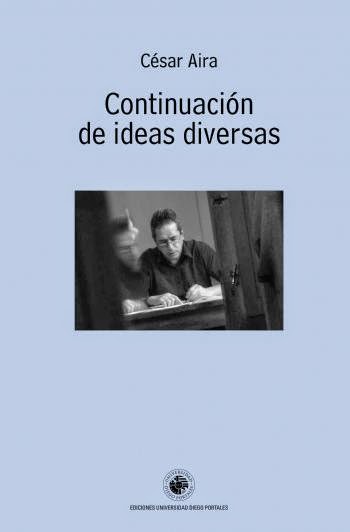
Continuación de ideas diversas

Continuación de ideas diversas (Ediciones Universidad Diego Portales, 2014)
by César Aira
Argentina, 2014

Two questions.  1) What might an ars poetica from César Aira look like?  2) How does Aira's nonfiction differ from his fiction?  Aira, last seen in these parts in connection with his fantastic 1990 novella Los Fantasmas, inadvertently answers both of these questions during the course of this amusing, playful, occasionally reader-baiting Continuación de ideas diversas [Continuation of Various Ideas]--an 86-page long free association of ideas on reading, writing, art and etc. in which Borges, Kafka and Raymond Roussel get lots of love and in which both the conventional novel and Julio Cortázar get trashed on multiple occasions.  A few examples.  "El modo más común de describir o recomendar novelas consiste en decir 'es sobre...', y a continuación poner el tema o ambiente o personajes: 'una familia disfuncional', 'los refugiados de la guerra en Sudán', 'dos jóvenes que buscan su vocación'..." ["The most common way of describing or recommending novels consists in saying 'it's about...,' and in what follows referring to the theme or the setting or the characters: 'a dysfunctional family,' 'refugees from the war in Sudan,' 'two youths in search of their vocation'..."], Aira writes.  "Las críticas o reseñas hechas por profesionales no son muy distintas" ["The criticism or reviews done by professionals aren't very different"], he adds.  "Si la recomendación es muy enfática, el relato de la temática se extiende y detalla, y eso es todo" ["If it's a very strong recommendation, the discussion of the subject matter gets more drawn out and detailed, that's all"].  The problem with this approach? "Pero la literatura es forma.  Esas descripciones o recomendaciones no dicen nada sobre el mérito o demérito literario de la novela" ["But literature is form.  Those descriptions or recommendations don't say anything about the literary merit or lack of merit of the novel"].  The next part is the best in terms of Aira's insight as a critic of critics--let's just hope I don't muck up the translation too much for you to appreciate the subtle irony: "El hecho de que sea casi imposible hablar de una novela sin decir en algún momento 'es sobre...' debería significar algo sobre el género novela o la 'forma novela'.  Ese algo puede ser o bien que la forma de la novela sea su materia, o bien que indique el triunfo de la materia sobre la forma, vale decir una derrota de la literatura en su formato más exitoso" ["The fact that it's almost impossible to talk about a novel without at one point saying 'it's about...' ought to signify something about the novel genre or about the 'novel form.'  That something might be either that the form of the novel is its subject matter or that it indicates the triumph of subject matter over form--which is to say a defeat of literature in its most successful format"] (23).  Elsewhere, Aira takes a more lightheartedly self-critical look at matters of reading tastes and the craft of writing when he admits that when "leyendo novelas policiales, buenas, apasionantes... me pregunto por qué yo no escribo así.  ¿Qué razón hay para escribir estos vanguardismos que escribo yo?" ["reading detective novels, good ones, thrilling ones... I ask myself why I don't write like that.  What reason is there to write these little avant-gardisms that I write?"].  Although he answers this question with what for me was a disarmingly simple proposition--the notion that reading and writing are "dos actividades radicalmente distintas" ["two radically different activities"] with corresponding "distintos objetivos" ["different objectives"] to match (54)--a much more colorful explanation comes in the form of an earlier passage in which he says that the Superman comics of the '50s and '60s were "la principal influencia" ["the main influence"] in his writing life.  "Ahí estaba todo lo que yo después quise hacer escribiendo, y en cierta medida, hasta donde pude, hice" ["There was to be found everything which I later wanted to do in writing, and in a way, to the extent that was possible for me, I did"].  What was it about these comics that was so appealing?  For one thing, "los argumentos tenían muy poca psicología, en su lugar tenían siempre un sutil juego intelectual" ["the plots had very little psychology; in lieu of that, they always had a subtle intellectual game instead"].  Along with that, the artwork.  "Y los colores, sobre todos los colores, claros, hermosos como un amanecer o como el pensamiento cuando se enfrenta a la aventura de la inteligencia" ["And the colors, above all the colors, bright, beautiful like a dawn or like the mind when confronted with the adventure of intelligence"].  According to Aira, Borges and "las revelaciones posteriores (Lautréamont, Marianne Moore, por nombrar dos)" ["later revelations (Lautréamont, Marianne Moore, to name two)"] were the beneficiaries of how his comic book fandom prepared him for "el goce y el ejercicio pleno de la literatura" ["the enjoyment and the full exercise of literature"] as a result of the "el hechizo persistente de los dibujos, los colores, la visibilidad intensiva de las reglas de juego de la ficción de Superman" ["the enduring spell cast by the drawings, the colors, the intense visibility of the rules of the game of Superman's fiction"] (46-47).  Having spent more time on this post than I'd intended without even once touching upon how the slippery Aira, self-described as "un lector muy precozmente intelectual, muy highbrow y no poco snob, muy literario" ["a precociously intellectual reader, very highbrow and more than a little snobbish, very literary"] who at the age of 14 already "quería ser un gran escritor, un genio, como Kafka o Proust" ["wanted to be a great writer, a genius, like Kafka or Proust"] but was troubled by how those writers "estaban cargados con la inmensa responsibilidad de mantener la calidad, de construir su Obra-Vida, de no apearse del monumental camello de lo Sublime" ["were charged with the immense responsibility of maintaining a high quality, of constructing their Life's Work, and of not falling off the monumental camel of the sublime"] (37-38) in contrast to the writers of the cowboy novels that his dad was a fan of who could write whatever they wanted and who had nothing to fear from the critics, differs in his nonfiction voice from his fictional voice, let me brief at last: not much.  Here, for example, is just one fragment out of many sporting the same sort of trace of a conceptual slap in the face that you can also find in his novellas (85):

Uno de los varios motivos por los que me opongo a la promoción de la lectura es el más evidente de todos, y por ello el menos visible: los libros están llenos de vulgaridad, prejuicios, estereotipos, falsedades.  Su frecuentación no puede sino embotar el pensamiento y la sensibilidad, distorsionar las ideas, falsificar la experiencia.
Se dirá que los buenos libros no son así, y que producen los efectos contrarios a éstos.  De acuerdo, pero los únicos que leen buenos libros son los que leen desde siempre y no necesitan campañas de promoción de la lectura.  Los que no han leído, y se deciden a hacerlo por una de estas campañas, necesariamente van a leer libros malos.

[One of the various reasons I'm opposed to the promotion of reading is the most evident of all and, because of that, the least visible: books are full of banality, prejudices, stereotypes, falsehoods.  Frequenting them can only dull one's sensibility and thinking, distort ideas, falsify experience.
It will be said that good books aren't like that and that they produce effects contrary to these.  Agreed, but the only people who read good books are the ones who have been reading them for forever and they don't need any publicity campaigns for reading.  Those who don't read, but who decide to do it because of one of these publicity campaigns, are necessarily going to read bad books.]

César Aira

I hope to share another Aira post or two with you later in the month.  In the meantime, here's one more snippet from Continuación de ideas diversas (page 55) since who knows when or if it will ever make its way into English:

Lo difícil es escribir, no escribir bien.  En los talleres literarios se puede aprender a escribir bien, pero no a escribir.  Para escribir bien hay recetas, consejos útiles, un aprendizaje.  Escribir, en cambio, es una decisión de vida, que se realiza con todos los actos de la vida.

[The difficult thing is writing, not writing well.  In writing workshops, one can learn to write well but not to write.  To write well, there are instruction manuals, useful advice, an apprenticeship.  Writing, on the other hand, is a life decision which is realized with all the actions in one's life.]

martes, 1 de julio de 2014

¡Bienvenidos a Spanish Lit Month 2014!

Bienvenidos a/Welcome to Spanish Lit Month 2014, a month-long celebration of Spanish language literature read in the original español or in translation in the language of your choice.  Thanks to Stu of Winstonsdad's Blog for coming up with the idea for the event in the first place and for asking me to co-host it with him back in 2012 and now again in 2014.  Thanks as well to all of you who have agreed to read and review a work for the festivities this year.  By the way, the link above should include the names of almost everybody who's said they'll be participating; however, there's always room for more if anybody else would like to join us during the course of the month.  Feel free to leave a comment here if I've missed you or if you'd like to make sure I know about any of your Spanish Lit Month posts.  For now, I'm planning on running weekly links round-ups on Sundays throughout July.  As far as what I'll be reading for the event, your guess is as good as mine!  However, the closest things to a certainty at the moment are a) Guillermo Cabrera Infante's Tres tristes tigres [Three Trapped Tigers], one of our two group read choices for the end of the month alongside Gabriel García Márquez's Noticia de un secuestro [News of a Kidnapping], and b) a new César Aira book that was brought back from Chile for me just yesterday thanks to a very kind coworker.  Anyway, hope to see you around during the event.  ¡Saludos!/Cheers!

miércoles, 25 de junio de 2014

Bosque quemado

Bosque quemado (Random House Mondadori, 2008)
por Roberto Brodsky
Chile, 2007

Bosque quemado, al parecer una obra de carácter fuertemente autobiográfico, se trata de la relación padre-hijo tensa entre un cardiólogo comunista chileno y su hijo adolescente después del golpe de Estado de 1973 que provocó sus huidas al exilio.  Dado que el narrador sin nombre y su padre Moisés están obligados a dejar la Argentina después de dejar de Chile ("Para entonces ya sonaba la alerta roja en la comunidad de los exiliados.  En las semanas precedentes, los cuerpos quemados y sin vida de chilenos, uruguayos y argentinos reconocidamente izquierdistas habían sido encontrados en los alrededores del aeropuerto de Ezeiza" [54]), también se trata de las peripecias involucradas en mantener una identidad cultural y/o nacional como parte de una diáspora porque casi todos los vínculos con el pasado de los dos hombres se han sido cortados.  Una ironía histórica terrible en el caso del padre, un hombre de ascendencia judía y él mismo el hijo de inmigrantes europeos.  O como el narrador lo explica al llegar a Venezuela, su padre "había salvado el pellejo huyendo de Buenos Aires a Caracas como antes lo hiciera  la corajuda Ana desde el progromo ucranio, y con eso bastaba.  En cuanto a mí, no había mayor novedad: mi padre era mi país, mi patria portátil.  Yo sería del lugar donde estuviese él" (70).  Un buen plan lo de quedarse con el padre, tal vez, pero desgraciadamente para el personaje un plan que no esté destinado a durar a lo largo de un exilio que eventualmente durará una década y que verá el "doctor Chile" en Venezuela y el narrador en España aguantando la desilusión y las noticias de las desaparencias y las muertes de sus amigos y familiares.  A pesar de unos momentos poco interesantes relacionados con una aventura amorosa del narrador después de su regreso a Chile, Bosque quemado a mí me pareció ser una muy buena novela, impactante y sutil, en su totalidad.  Hay una muy bien escrita escena hacia el final, por ejemplo, en que el narrador dice a su mujer que él está escribiendo algo que es "una mezcla" en términos del género de la obra: "ni puramenta novela ni tampoco biografía, en sentido estricto.  Es ficción, en el fondo" (197).  ¿Está el personaje describiendo la novela de Brodsky?  Quizá, pero lo interesante de la descripción no es su aspecto de metaficción dentro de un libro que es empapado en un realismo duro sino la reflexión introspectiva que la precede en el texto: "una obra literaria no es un ajuste de cuentas", escribe el narrador, "no había revancha que tomar" (196).  El éxito de Brodsky, me parece, proviene de justo esta paradoja argumental: en un libro cargado de un indecible tristeza  --y en un libro en que el propio título viene de una descripción de la enfermedad de Alzheimer, la aflicción que arrasará los "recuerdos, referencias, memoria, todo" (124) del cardiológo Moisés como otro robo de su identidad después de su regreso a su país natal-- el novelista ha escrito algo que produce honda emoción y que es fiel a la idea que el exilio está lleno de una "tristeza chejoviana" (130) al mismo tiempo que ha escrito algo que no se parece a un ajuste de cuentas.  Un logro eso, ¿no?  En todo caso, Ignacio Echevarría, en su comentario sobre Bosque quemado en la página 132 de Los libros esenciales de la literatura en español: narrativa de 1950 a nuestros días, elogia la obra con aun más entusiasmo: "Ninguna otra novela, hasta el momento, ha acertado a ilustrar mejor el drama de quienes, empujados al exilio por las feroces dictaduras que asolaron Latinoamérica en los años setenta, permanecieron fieles a una memoria y a unos idearios que los dueños y usuarios de las restauradas democracias obviaron, en un ejercicio de amnesia colectiva que hizo de ciertos ideales también un bosque quemado".

Roberto Brodsky