Mostrando las entradas con la etiqueta Books on France 2014 Reading Challenge. Mostrar todas las entradas

martes, 28 de octubre de 2014

Morituri

Morituri (Gallimard, 2008)
by Yasmina Khadra
Algeria, 1997

When Tom from Wuthering Expectations kindly recommended Yasmina Khadra to me in response to this post for a "pure nightmare" evocation of Algeria in the 1990s, I wasn't worried that he was trying to dial things back when he later added "I'm not even sure Morituri is a good book, but who cares?"  And why should I have been?  I could see what Tom was talking about just from the novel's jolting opening line: "Saigné aux quatre veines, l'horizon accouche à la césarienne d'un jour qui, finalement, n'aura pas merité sa peine" ["Bled white, the skyline gives birth by C-section to a day, which, in the end, won't have been worth the trouble"] (459).  Morituri, nominally a vaguely Chandleresque policier having to do with a missing persons case but in reality just a pretext for Khadra (real name: Mohammed Moulessehoul; 1997 day job: officer in the Algerian army) to vent his spleen about the "olympiades terroristes" ["terrorist Olympics"] (571) that had descended upon his native country during Algeria's nasty civil war, delivers the mystery/thriller goods aplenty via a blistering, high octane pace--sort of a book version of the no-huddle offense--and a dark, plot-driven police procedural prominently featuring booby-trapped corpses, carbombings, and religiously motivated celebrity assassinations in addition to the usual mix of more civilized crimes.  Why would anybody want to "experience" Algeria in such a visceral realism way much less under the guise of entertainment?  Why not?  I missed the adrenaline rush provided by the novel when it was over, and even though Khadra's portrait of post-independence Algiers as a fear-filled Hell on the Mediterranean was just a little too grounded in the reality of its time and place for me to want to follow in Commissaire Llob's footsteps for tourism purposes in real life anytime soon, I did find it mightily refreshing to make the acquaintance of a "genre writer" whose hard-nosed prose, astonishingly enough, was often just as violent and corrosive and jittery as his subject matter: "Drôle d'époque!  Lorsqu'un collègue est tué par balle, on estime que c'est ce qui pouvait lui arriver de mieux - au vu des cadavres horriblement dépecés qui jalonnent la malheureuse terre d'Algérie" ["A funny thing about the era!  When a colleague dies from a bullet, we deem it to be the best thing that could have happened to him given the horribly carved up dead bodies strung out throughout the length of the wretched soil of Algeria"] (548).

Mohammed Moulessehoul

Morituri, Latin for "those who are about to die," appears on pp. 453-599 of Yasmina Khadra's Le quatuor algérien omnibus (Paris: Éditions Gallimard, 2008) alongside the 1997 Double blanc, the 1998 L'automne des chimères, and the 2004 La part du mort.  Thanks to Tom for bringing Khadra/Moulessehoul to my attention.

viernes, 24 de octubre de 2014

Abbés


Abbés (Éditions Verdier, 2002)
by Pierre Michon
France, 2002

Abbés [Abbots], a 71-page triptych of three "imaginary lives" dedicated to monastic figures from France's Vendée département around the year 1000 and hence at least outwardly concerned with colorfully antiquated things like furta sacra, the reading or misreading of portents, and the propagation of the faith in the still quasi-pagan marsh and swampland region of the old Vendée, etc., wasn't all that convincing to me from a historical fiction or a "medieval" or even a spiritual point of view even though I readily admit that it was rather satisfying from a post-Marcel Schwob/non-Sigrid Undset-like scandalous storytelling point of view.  Who needs historical fiction anyway?  In other words, the not entirely tame account of abbot Èble's struggles with the spirit and the flesh? A disappointing and played-out plot device, truth be told.  But the descriptions of abbot Èble's struggles with the spirit and the flesh?  Priceless!  Too bad my schoolboy French isn't good enough for me to know whether I was supposed to laugh out loud or be outraged whenever the talk of an adulterous liaison deteriorated into overheated lines about a proud monk's carnal enjoyment of a woman's "plaie de feu mouillé" ["wound of moist fire"] (22) or the like.  It's an odd and occasionally unsettling book in that regard.  In terms of coming to grips with Michon's rep as one of contemporary France's premier prose stylists, though, it's pretty easy to see why his fans get so geeked up over his writing.  In the matter of imagery alone, for example, the pages of Abbés are teeming with tactile audiovisual allusions to nature (cf. "Un jour de janvier, la mer pleure comme un petit enfant sous un ciel de craie" ["One day in January, the sea wails like a little baby under a chalky sky"]) (65) which did a number on me with their trimmings of poetry in prose.  Michon's also an able practitioner of the bookish practical joke, permitting his narrator to gloss on the conventional nature of the old secondhand chronicles he's supposedly borrowing his historical source material from ("La haute époque avec ses belles images, scribes appliqués et chevaux" ["The Middle Ages with its beautiful images, studious scribes and horses"]) before blindsiding you with an even more disparaging antiquarian aesthetic feint: "Je suis fatigué de ses images, de la fade Chronique de Pierre" ["I'm tired of these images, tired of Pierre's insipid History"] (50).  Of course, the practical joking gets even better--richer, more layered, more Borgesian--when you start to realize that Pierre de Maillezais the chronicler might bear more than a passing resemblance to Pierre de Châtelus-le-Marcheix the modern day "scribe" of Abbés and that a "chance" reference to medieval monk/historian/literary forger Adémar de Chabannes might have something meta to say about the underhanded creativity and inspiration at the heart of the reading, writing and rewriting processes themselves.  Like I said, who the hell needs historical fiction anyway?

Pierre Michon

Cette époque, on le sait, aime les os.  Pas tous les os, ils ont grand soin de choisir, disputent et parfois s'entretuent sur ce choix: les os seulement qu'on peut revêtir d'un texte, le Texte écrit il y a mille ans ou les textes écrits il y a cent ans, ou le texte qu'on écrit à l'instant pour eux, les os que Cluny ou Saint-Denis a nommés et scellés, ceux qui à des signes patents pour nous illisibles, firent partie d'une carcasse d'oú s'évasait la parole de Dieu, la carcasse d'un saint.  Comment ils décident que tel os sera habillé et nommé, exhibé sous les yeux des hommes dans de l'or, et tel autre anonyme et nu, bon pour la terre aveugle, nous ne le comprenons pas, seuls les mots de cynisme ou de parfaite naïveté nous viennent à l'ésprit, mais sûrement pas les mots de savoir et de vérité.  Nous béons devant ces châsses au fond d'églises froides, il faut mettre une pièce de monnaie pour qu'elles sortent de l'ombre, nous béons devant le petit cartel qui résume la vie du saint, toujours la même en somme, les nuances nous échappent comme elles ont échappé au rédacteur du cartel, nous nous ennuyons bien avant que la loupiote s'éteigne, ces carbonates de calcium noirs entrevus sous une petite lucarne crasseuse nous dégoûtent - et les châsses, l'art n'en est pas bien compliqué, en dépit de l'épaisseur des catalogues qui entendent prouver que si, c'est compliqué.  Nous avons vu les signes, qui ne signifient plus rien.  Mais en sortant sous le soleil face au parking devant l'église, pour peu que cinq heures sonnent au clocher sur nos têtes, pour peu que des oiseaux s'envolent ou qu'un rétroviseur nous éblouisse, une exaltation mélangée nous reprend, parce que sur ce même parvis sous le soleil ce que nous ne comprenons pas, c'ést-à-dire l'os et l'or et le texte mêlés, cela a eté brandi par des prélats cyniques ou savants devant des foules naïves ou véridiques, bouleversées. Dans la voiture nous feuilletons le catalogue épais des Musées nationaux, auquel nous, nous croyons, cynisme ou crédulité.  Nous partons dans octobre ensoleillé, dans octobre noyé Théodelin et ses moines arrivent à Charroux.

[The era, as we know, loves bones.  Not all bones--they're careful to choose; they argue and sometimes kill one another over these choices: only the bones that can be arrayed in a text--the Text written a thousand years ago, or the texts written a hundred years previously, or the text that was written for them the minute before--the bones that Cluny or Saint-Denis have named and sealed, those that, according to patently visible signs which are now illegible to us, were once part of a human frame from which the word of God emanated, the human frame of a saint.  How they decided that one bone was to be dressed and named, displayed in gold before the eyes of men, and that another, anonymous and naked, was fit only for the blind earth we cannot understand, and only the words cynicism or utter credulity come to mind, but certainly not the words knowledge and truth.  We gawp at these reliquaries in the depths of cold churches (you have to place a coin in a slot for them to emerge from the shadows), we gawp at the little notice that summarizes the saint's life which is always fundamentally the same one; the nuances escape us as they have escaped the writer of the notice; we are bored long before the little bulb goes out, the black calcium carbonates glimpsed through the grimy little window revolt us--and the artistry of the reliquaries is not particularly complicated, despite the thickness of the catalogues intent on proving that it is.  We've seen the signs which no longer signify.  But as we step out into the sunshine and look toward the carpark in front of the church, if five o'clock is striking in the tower above our heads, or if a few birds fly up or a wing mirror dazzles us, a mixed elation takes hold of us because on this same portico in the sunshine the thing we cannot understand--the bone and the gold and the written words all mixed together--was brandished by cynical or knowledgeable prelates before credulous or genuine crowds who were deeply affected by it.  Inside the car we leaf through the thick catalogue of national museums which we do believe in, whether out of cynicism or credulity.  We drive off in the October sunshine, and in an October downpour Theodelin and his monks arrive at Charroux.]

Thanks to Victoria for recommending Michon's Abbés to me.  The excerpt above comes from pp. 56-58 in the original, and the lovely translation accompanying it comes from pp. 103-104 of Ann Jefferson's Michon translation twofer Winter Mythologies and Abbots, which is available from Yale University Press.

sábado, 11 de octubre de 2014

Les bouts de bois de Dieu

Les bouts de bois de Dieu (Pocket, 2012)
by Ousmane Sembene
Senegal, 1960

Les bouts de bois de Dieu [God's Bits of Wood], my first but hopefully not my last Francophone selection for the Books on France 2014 Reading Challenge, is an eminently worthy, particularly hard-hitting rival to Tayeb Salih's Season of Migration to the North for the title of the best African novel I've read in the last five years.  Based on the real life 1947-48 Dakar-Niger railroad strike in which hundreds of African workers shut down the French-owned line for almost half a year in an effort to wrest some hard-fought concessions from the colonial management, Sembene's novel is a gritty social realism curiosity in the sense that the railway men and their families--rather than a single protagonist--serve as the main narrative center of attention throughout.  Is this ensemble dramatic focus an example of Sembene's Marxist politics and/or his filmmaking interests informing his storytelling style?  Perhaps.  However, what's more self-evident is that the vignette-laden panoramic approach perfectly suits the epic sweep of a story of a people gradually being driven to either sell out to or to stand up against their colonial oppressors as the toubabs [whites] try to break the strike by cutting off food sales to strikers and by committing shameful acts of violence against women and children and the elderly.  Ah, civilization and progress.  So what makes the novel so compelling apart from the novelty of the group protagonist thing?  For one thing, I can't think of the last novel I read that conveyed a more convincing sense of place.  Although Sembene stops short of demonizing the French colonials or idealizing the Senegalese and other Africans supporting the strike, his depiction of local color and politics is so surehanded that even a drunken Frenchman's acid characterization of the white quarters in the city of Thiès-- "Savez-vous ce que nous sommes ici, jeune homme?  un poste avancé en pays ennemi!" ["Do you know what we are here, young man?  A forward operating post in enemy territory!"] (259)--is more than enough to delineate the confrontational state of race relations in the land.  On a related note, having casually mentioned "social realism" and "colonial oppressors" in passing above, I should probably clarify that thematically Les bouts de bois de Dieu is less about heroic resistance than about the trickier matter strike leader Ibrahima Bakayoko is forced to ponder as the bodies of the strike supporters start to pile up during the course of events: "Comment se dresser sans haine contre l'injustice?" ["How do you rise up against injustice without hate?"] (368).  A thorny issue given its due complexity here in powerfully rendered scenes with unpredictable outcomes in which a Frenchwoman patronizingly refers to the African workers on strike as "demi-civilisés...enfants" ["half-civilized children"] (257) and a Senegalese woman tearfully asks "Est-ce qu'on ne pourrait pas tuer tous les Blancs?" ["Can't we kill all the whites?"] (295).  Finally, in addition to the expected examples of powerful storytelling to be found here such as the vignette about the old man who keels over weak from hunger and then becomes food for rats or the extended passage on the women's protest march to Dakar that takes place to the insistent accompaniment of loud tam-tams, Sembene leaves the reader two unexpected ironies to mull over having to do with the intersection between language and culture and politics: 1) Who would have ever thought that the novelization of a railroad strike could be so fascinating?  2) In a work which persistently alludes to the everyday use of various indigenous languages/dialects such as Bambara, Fula, Songhay, Toucouleur, and the novelist's own native Wolof in opposition to the colonial language that one Bambara-speaking character refers to as "ce langage de sauvages" ["this language of savages"] (20), what did Sembene have in mind by using French, the language of the oppressors, rather than Wolof, which Bakayoko claims "est notre langue" ["is our language"] (271), to tell this story?  Who, in short, is the target audience for the novel which, as luck would have it, was published in Marseille the same year Senegal gained its independence from France?  Whatever, a fucking knockout.

 Ousmane Sembene (1923-2007)

martes, 30 de septiembre de 2014

A Savage War of Peace: Algeria 1954-1962

A Savage War of Peace: Algeria 1954-1962 (NYRB Classics, 2006)
by Alistair Horne
England, 1977 & 2006

Having owned this fat 500+ page history for almost a full five years now according to the remaindered sticker on the front cover of my copy of it, I was genuinely relieved when I finally got around to finishing it both because it will never glare at me unloved from my TBR shelves again and, more to the point, Horne was just a little too good at documenting the widespread targeting of innocents in terrorist bombing campaigns and machine gun attacks, the many massacres, and all the atrocities that took place on both sides of the struggle during Algeria's war for independence.  That latter point is of course no knock on Horne or on his otherwise engrossing work informed by interviews with many of the winners and the losers of the war.  In any event, as somebody with virtually no prior knowledge of this moment in French/Algerian/French Algerian history, I thought A Savage War of Peace: Algeria 1954-1962 was more or less a model introduction to the subject of the death throes of what was once referred to as l'Algérie française.  In Part One's "Prelude 1830-1954," for example, Horne gets things started in setting up the backdrop to why mainland France would find achieving an Algerian compromise so difficult in the ensuing years by explaining that "in order to understand events from 1954 onward it is necessary to accept the existence of three totally distinct peoples - the French of France, the French of Algeria, and the Muslims of Algeria" (53-54).  In Part Two's "The War 1954-1958," Horne jumps right into the nitty gritty of the endless cycle of Muslim on white and white on Muslim violence and reprisals that will occupy his attention throughout the rest of the book, introducing the reader to such unpleasant terminology as the ratonnade (literally a "rat hunt" but here used as a euphemism for the vigilante violence entailing the rounding up and killing of Arabs as a form of blood sport revenge for violence suffered at the hands of Muslims by the pieds noirs or colonial Algerian white community) and to such topics as the Battle of Algiers and a blow by blow of the terror and torture tactics and extrajudicial killings employed by all sides during France's war with the F.L.N. (Front de Libération Nationale).  Part Three's "The Hardest of All Victories 1958-1962," primarily concerned with the end of the war in Algeria, the proliferation of pro-French Algeria right-wing extremist groups in Algeria opposed to both fellow Frenchmen and Muslim Algerians, and the eventual response of rebel French military factions so dismayed with de Gaulle's Algeria policy that they planned to take the war to the mainland and carry out a putsch on French soil, offers up more of the same but with a little more emphasis on political as opposed to military history; one French politico succinctly summarizes the mood among non-F.L.N. members with his dejected comment that "the relations between Algeria and France are a graveyard of missed opportunities" (528).  While aware that this rather bare bones outline of A Savage War of Peace doesn't really do justice to the amount of ground Horne covers in the book, I'd still like to shift gears and talk about the author as a writer rather than a historian for a moment.  Stylistically, Horne's work benefits from both the occasional well-turned phrase ("Revolt, and revenge in the Corsican fashion, were honored occupations from time immemorial," he writes about one sector of Algerian society early on [49]) and from the selection of memorable quotes ("Of the F.A.F. demonstrations, Mouloud Feraoun wrote contemptuously, 'they resemble senile beggars who masturbate in a corner to make people believe that they are virile'" [430]) that serve as a brief respite from all the neverending violence on display under the historian's microscope.  While Horne's a bit repetitive and maybe a tad old-fashioned in his biases at times--he makes several references to some variation of the description of "the blood-curdling you-you-you ululations" (431) of Muslim women, for example--perhaps that's a small price to pay given his predominantly bias-free account of years of butchery and torture and the sad but affecting way an Algerian moderate like Albert Camus gets written into and out of Horne's history as the violence escalates.  A monumental but a monumentally depressing piece of work.

Alistair Horne

miércoles, 24 de septiembre de 2014

Balzac x 3

Le Père Goriot (Gallimard, 2012)
by Honoré de Balzac
France, 1835

The Girl with the Golden Eyes [La Fille aux yeux d'or] (Melville House Publishing, 2007)
by Honoré de Balzac [translated from the French by Charlotte Mandel]
France, 1835

"Honoré de Balzac's 'Vision' of Paris"
by Owen Heathcote
England, 2013

In a brief but illuminating-for-this-particular-Balzac-neophyte essay on "Honoré de Balzac's 'Vision' of Paris" included in The Cambridge Companion to the Literature of Paris edited by Anna-Louise Milne (Cambridge and New York: Cambridge University Press, 2013, 71-84), Owen Heathcote makes the claim that "Balzac's appetite for observation"--and in particular his mythification of the city in print--"has contributed to establishing what 'Paris' is to such an extent that his vision is now inseparable from the so-called actual city.  It is no exaggeration to say that this author, famed for his 'realism,' also gave us the 'idea of Paris,' a 'paper cathedral' that absorbs the material world and replaces it with text" (74).  Whatever you make of the details of Heathcote's argument, his contention provides a convenient enough prism through which to view two Parisian novels which couldn't be more dissimilar in terms of artistic quality: Balzac's grand, wrenching Le Père Goriot and the same author's dreadful, often clownish The Girl with the Golden Eyes [La Fille aux yeux d'or].  How can thinking about these two works as examples of "Balzacian Parisian novels" help us to appreciate them in a different light than we might on purely aesthetic grounds?  As many of you already know, Le Père Goriot begins with a famous extended description of a down-at-the-heels boarding house home to a motley crew of Parisians and ends with an even more famous description of another sort of Parisian rest home, Père Lachaise cemetery, from which the no longer innocent Eugène de Rastignac, a transplanted provincial, surveys a panorama of the city which has just educated him in what it will take for him to survive amid all the meanness and scheming and social climbing of his new urban milieu.  The novel's worthy of its hype on many different levels, of course, but for my $$$ one of the not so secret secrets to its success is the way the impressionable young Rastignac is forced to choose between two role models--a charismatic criminal named Vautrin who, in the course of a nearly 10 page-long rant against society, tells Rastignac that the only two choices in life are between "une stupide obéissance ou la révolte" ["mindless obedience or revolt"] (147) and that "l'honnêteté ne sert à rien" ["honesty doesn't serve anyone"] (152), and the long-suffering title character, at one point described as "ce Christ de la Paternité" ["this Christ of fatherhood"] (282), who sacrifices everything for his two daughters' well-being only to be rejected by them in his hour of need.  Rastignac's choice should be clear but ultimately isn't given the accomplished and devastating high-wire act Balzac pulls off in the finale.  Unfortunately, where Le Père Goriot tells a story of substance and depth with appropriate references to local color even at its most melodramatic (for example, as early as the third page in, a mention of the Catacombs leads the narrator to blurt out--"Comparaison vraie!  Qui décidera de ce qui est plus horrible à voir, ou des coeurs desséches, ou des crânes vides?" ["A true comparison!  For who can say what's more horrible to observe: either dried-up hearts or empty skulls?"] [23]), The Girl with the Golden Eyes is hollow, bombastic and buffoonish in its telling of what's essentially a pulp love story.  Which is not to say that the descriptions of "the soul of Paris" being responsible for its "cadaverous physiognomy" (4) aren't amusing or that the narrator's claim that "all passion in Paris is focused on two goals: gold and pleasure" (21) is any less serious a critique of the headlong pursuit of power and wealth than the one found in Le Père Goriot.  However, unintentionally funny lines like the description of hero Henri de Marsay's "slim, aristocratic waist" (34) and howlers like the Girl with the Golden Eyes' description of a love nest as "this retreat was built for love" (87) read more like a parody of a gothic novel which just happens to be set in Paris rather than the complex statement about Paris Balzac set down in Le Pére Goriot.  Heathcote, interestingly enough, provides one reason to consider taking The Girl with the Golden Eyes seriously in speaking of the "feminisation of Paris which runs throughout La Comédie humaine."  Although it pains me to even think about ever reading the ridiculous The Girl with the Golden Eyes again, I must confess that Heathcote almost tempts me with his provocative assertion that just as "'Woman,' like Paris" is both "an enigma to be solved" and "a territory to be conquered" for Le Père Goriot's Rastignac, "if, moreover, as will be seen in La Fille aux yeux d'or, Paris is also associated with the courtesans of ancient Babylon or imperial Rome, then the identification of woman and Paris extends back in time and over space: the feminisation of Paris facilitates the transformation of description into myth and the transformation of La Comédie humaine into a new, but age-old, epic with Paris as its epicentre.  At the same time, Paris also becomes a new, nineteenth century hell - both as irresistible lure and as inescapable labyrinth" (75).  Interesting thoughts to be sure--although Heathcote clearly missed a chance to go after some low-hanging fruit when he neglected to associate The Girl with the Golden Eyes' description of an elderly woman as "the old mummy" (72) with the ancient Egyptians as he maybe could have and should have given all that ancient Babylon and imperial Rome talk.  Whatever!


Le Père Goriot and The Girl with the Golden Eyes were books #8 and #9 out of a projected vingt-quatre read for the Books on France 2014 Reading Challenge.  Still way off the pace but a little less so than I was a month ago.  No need to play the all-novellas-in-translation card just yet, but there may be after Germinal!

domingo, 31 de agosto de 2014

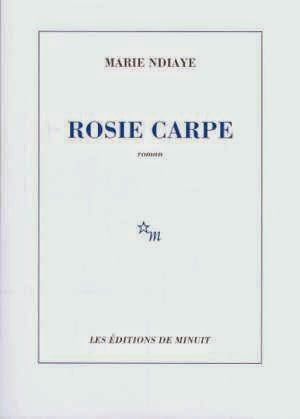
Rosie Carpe

Rosie Carpe (Les Éditions de Minuit, 2001)
by Marie NDiaye
France, 2001

Rosie Carpe, the 2001 Prix Femina winner that's sort of a fucked-up distant cousin cousine to Pedro Páramo in some respects, was pretty much half gripping and half grating during the time I was reading it.  So while I try to sort out just how much I "liked" the book, I'll try to give you a couple of ideas as to why this wasn't/isn't immediately clear to me despite the fact that I found it a rewarding read for plenty of other reasons.  In the opening sequence, the title character is introduced to us as a 20-something white Frenchwoman who arrives in Guadeloupe looking for her trouble-prone older brother, Lazare, whom she hasn't seen in the five years since he bummed money off her to start a shady sex toy business in the Antilles.  At the airport, she's met by a friendly but somewhat reserved black man sent by Lazare, Lagrand, whom she momentarily mistakes for her pale white brother for some reason or other that's initially unclear.  Nonsensical and annoying?  Totally!  At least until you realize that something's really, really wrong with Rosie, the unwed mother of a five year old boy who's also pregnant with another child on the way, and the text is only, ahem, faithfully replicating the character's fragmented, traumatized point(s) of view.  As luck would have it, the supposed island paradise of Guadeloupe--like Juan Preciado's phantasmal Mexican town of Comala in the Rulfo novel--turns out to be sort of an otherworldly destination point for Rosie with the important distinction that, unlike in Pedro Páramo, the protagonist here is only surrounded by the living dead--i.e. emotional vampires who feed off others--rather than the actual dead throughout most of her odyssey and eventual metamorphosis.  Although the symbolic undead/vampirism connections in the novel are so strong that at one point a hummingbird lands on one particularly evil character's feet and almost immediately keels over dead and at another point the increasingly distressed Lagrand responds to the specter of dozens of rats running loose under the guava trees with the assumption that they will naturally follow in another character's footsteps as familiars or minions, NDiaye sees to it that a sleazy, post-milennial realism usually keeps the more hallucinatory, nightmarish moments in check in the form of several powerful scenes involving amateur porn filmmakers, the death by machete of an innocent tourist, the bizarre discovery that the uncaring parents who'd abandoned Rosie and Lazare to their fates back home in metropolitan France had followed Lazare to Guadeloupe and are now happier than ever as the result of a rather incestuous mate-swapping arrangement, and--in a top that child endangerment coda--the prostitution of a beautiful young girl by her parents.  With all that as a backdrop, is it any surprise that the troubled Rosie will eventually decide that her happiness as a woman may come at the expense of the loss of one her children as a mother in something resembling the biblical sacrifice of the slaughter of the lambs?  NDiaye obviously gives you a lot to think about in Rosie Carpe, but as I've already touched on not all of it worked for me.  My major complaint has to do with the handling of the POV of the various characters.  In the long third chapter dedicated to Lagrand, for example, the fact that his perspective was related in the same claustrophobic way as Rosie's earlier on in the work was frustrating to me since it came without any apparent explanation for the similarities in style.  Had Lagrand's feelings for Rosie miraculously transformed this apparent innocent into "le réceptacle de toutes les tristesses et les vilenies" ["the receptacle for all the sorrows and all the baseness"] (235) that the freak magnet of a title character had suffered as for all her life?  Or was Lagrand merely suddenly going mad without warning like the mother who had abandoned him when he was a ten year old?  Whatever, I found this part unconvincing and tiring in stretches at the expense of some otherwise top notch, aggressively risky storytelling.  A related but much more minor complaint stems from the fact that with an entire cast full of madwomen in the attic so to speak, the grist of the novel was way over the top at times.  Perhaps this was unavoidable given the scope of the novelist's ambitions and her attempt to breathe life into a lonely, damaged title character self-described as "ne se sentant plus être que l'insignifiante enveloppe charnelle de Rosie Carpe" ["not feeling herself to be anything other than the insignificant carnal shell of Rosie Carpe"] (149) rather than a fully realized person.  On the positive side of things, though, I was endlessly fascinated by NDiaye's Gérard de Nerval-like use of colors, her utter unpredictability as a writer, and the often sensuous appeal of her prose despite the brutality and the squalor that are also present.  Probably the best single example of this in the entire novel is the lovely, even fragrant extended description of "une toute jeune fille" ["a very young girl"] who is perceived rather than actually seen by Lagrand as akin to "une longue flamme échappée du jardin" ["a long flame which had escaped from the garden"] and the bearer of a perfume reminiscent of the "tièdeur profonde de terre ou de sable au soleil" ["profound warmth of earth or sand in the sun"]--well, at least you might think it's lovely until you realize that "cette forme lumineuse, vibrante" ["this luminous, vibrant form"] and "cette incandescence en mouvement" ["this incandescence in motion"] (331), so appealing to both children and adults alike in the scene, is the very same girl who will later be put to work as a prostitute by her loving parents.  Ladies and gentlemen, je vous présente Marie NDiaye.

Marie NDiaye

Thanks to Victoria/Litlove from Tales from the Reading Room for recommending Marie NDiaye to me earlier in the year.  For those interested in Victoria's take on Rosie Carpe and its place within a personal canon of French literature c. 2006, please see Victoria's inviting words here.  The novel is also available in an English translation under the same name prepared by Tamsin Black for the University of Nebraska Press' European Women Writers series.

lunes, 25 de agosto de 2014

Hell in a Very Small Place: The Siege of Dien Bien Phu

Hell in a Very Small Place: The Siege of Dien Bien Phu (Da Capo Press, 2002)
by Bernard B. Fall
USA, 1966

While I probably should have known better given all the raves I've heard about it over the years from reliable people as close to me as my dad, Bernard B. Fall's Hell in a Very Small Place: The Siege of Dien Bien Phu, the classic account of the punishing 56-day 1954 battle between the French and the Viet-Minh that effectively ended France's control over French Indochina forever, marked "the end of France as a colonial power" (414), and paved the way for the U.S. entanglement in Vietnam less than a decade later, still managed to sneak up on me.  Surprised me with its narrative intensity.  Surprised me with Fall's smarts as an analyst.  Surprised me with its ability to suss out the heroism and bedrock humanity of men engaged in the most inhumane of human activities without ever once glamorizing war or demonizing the enemy.  Fall, an Austrian-born, French-raised Jew who lost both his parents to the Nazis before moving to the U.S. to become a history professor at Howard University and a war reporter for publications as elite as The New York Times and The Washington Post, himself died less than a year after publication of Hell in a Very Small Place while out on patrol with U.S. Marines near Huê in central Vietnam, which for this reader lent an additional, retrospective element of solemnity to the reading of his requiem in prose.  But for others perhaps less readily swayed by the parallels between Fall's fate and his subjects', what can his history offer?  For starters, for all its harrowing moments involving artillery barrages, trench warfare and the like, this book is also so full of "novelistic" twists and turns that it's just mindboggling.  In terms of the "characters" alone, for example, there's the great unexpected vignette dedicated to one Sgt. Rouzic, who "in civilian life had been the driver of the getaway car of France's most famous postwar gangster, Pierrot-le-Fou (Pierre the Crazy One) and had decided to join the French army in Indochina when the French police began to close in on his employer" (147) and then there's the more down to earth but equally compelling story of the Algerian Legion of Honor medalist Lt. Belabiche, accused of being "just another 'lackey of the imperialists'" by his Viet Minh captor but of whom we learn, in a patriotic twist of fate, "eight years later, Belabiche was a captain in the Algerian National Liberation army, training young Algerian officers at what had been the French officers candidate school at Cherchell, west of Algiers" (420).  In terms of analysis, Hell in a Very Small Place shines for both its soundbites--Fall's retort to a hypocritical publicity memorandum that the inadequately supplied "defenders of Dien Bien Phu have up to now covered themselves with glory and are an object of admiration for the Free World" is derisory: "The price of that unsullied glory," he writes, "came to 5,000 dead, 10,000 prisoners, and a lost war" (361)--and for the far more complicated work spent shedding light on matters previously left in the dark.  For example, two weeks into the battle in a matter that Fall states "has never been fully explained," a Lt. Col. Langlais apparently took over responsibility for the defense of Dien Bien Phu from a withdrawn Gen. de Castries when "according to senior officers who were eyewitnesses to part of the drama, Lt. Col. Langlais, flanked by the fully armed commanders of the paratroop battalions at Dien Bien Phu, entered de Castries' office and bluntly told him that henceforth the effective command of the fortress would be in his own hands, but that as far as the outside world was concerned de Castries would retain the appearance of command and would serve as an intermediary between the paratroop commanders and Hanoi" (177).  Whether this smacks of decisiveness or desperation on the part of the besieged garrison's top defenders is beyond my ability to say.  However, I found Fall's explanation thoroughly convincing and typical of his own calm under pressure as a historian of the battle: "In view of the subsequently excellent personal relations between Langlais and de Castries, it is difficult to describe what happened on March 24 as a 'mutiny' or a Putsch by what some staff officers called the 'paratroop Mafia' or 'Langlais' Brain Trust.'....  To paraphrase a senior officer who was there, GAP 2 logically took the place of a command organization that no longer existed, and exercised prerogatives whose effective usage the commander of the fortress had ceased to exercise" (177, ellipses added).  Finally, the work offers up any number of tributes to the fighting spirit and the arguably futile sacrifices on display at Dien Bien Phu as in this one, regarding the French Foreign Legion members who cried when their friends prepared to attempt a breakout, "not for fear of their fate, for it was known by then that the Communists did not massacre prisoners, but out of shame that they would have to surrender to the enemy" (398), and in this one, regarding the dead who were left to rot on the battlefield when it was all over: "Most of the French dead are, like royalty, swathed in silk shrouds.  Parachute nylon, like courage, was one of the common items at Dien Bien Phu, and on both sides" (449).  As I probably should have expected, a tour de force.

Bernard B. Fall (1926-1967)

domingo, 10 de agosto de 2014

Le Ravissement de Lol V. Stein

Le Ravissement de Lol V. Stein (Gallimard, 2011)
por Marguerite Duras
Francia, 1964

Le Ravissement de Lol V. Stein [publicada en castellano como El arrebato de Lol V. Stein], de Marguerite Duras, ha fortalecido la posición de la francesa dentro de mi panteón de escritores favoritos al costado de cracks ríoplatenses como Juan Carlos Onetti y Juan José Saer entre otros.  A la edad de 19 años, la protagonista Lol/Lola Valérie Stein supuestamente perdió la razón cuando su prometido la dejó plantada a un baile al casino municipal de T. Beach en vísperas de sus desposorios.  Se encerró en su cuarto.  Dejó de hablar.  Luego de llorar y llorar, sufrió en silencio.  Diez años más tarde, casada con otro hombre, madre de tres niños y, al parecer, recuperada de la locura transitoria de su juventud, Lol regresa a la ciudad vecina de S. Tahla para enfrentar a los fantasmas del pasado.  ¿Va a sufrir otra derrota en el pueblo en que todo el mundo ya conoce la historia de su ruina?  Al igual que Onetti y Saer, Duras explota todas las posibilidades de la trama y juega con una variedad de perspectivas narrativas con toda la destreza de un cirujano con una navaja en la mano.  Por ejemplo, ambos el estado afectivo de Stein y su subjetividad como el eje central de la novela se establecen mediante la escritura de un narrador, un tal Jacques Hold, que admite ser un mentiroso y que además está involucrado en una suerte de triángulo de amor con Lol y con otra mujer casada, Tatiana Karl, una amiga de la infancia de Lol.  Esto implica que la historia personal del trauma de Lol pertenece menos a ella y más a los otros personajes en el entorno de S. Tahla: una ironía terrible dada que los dolores de Stein, en el pasado y en el presente, se describen en un momento clave como un infierno personal en cuanto a "l'eternité du bal dans le cinéma de Lol V. Stein" ["la eternidad del baile dentro del cinema de Lol V. Stein"] (309).  En otra parte, el marido de Tatiana Karl opina que "Lol V. Stein est encore malade...et c'est sans doute ça qui intéresse Jacques Hold" ["Lol V. Stein todavía está enferma...y esto probablemente sea lo que interesa a Jacques Hold"] (368).  Llegado a este punto, el lector puede preguntarse a sí mismo si el problema en lo que se refiere al tema general de la novela queda con el amor fracasado o con el amor ello mismo en el sentido en que el amor pueda ser una especie de enfermedad.  Por su parte, Duras es más bien ambigua.  La casada Lol V. Stein dice en algún momento que "le meilleur de tous les hommes est mort pour moi" ["el mejor de todos los hombres está muerto para mí"] (336), y este comentario tristísimo está acompañado por descripciones llamativas de ella como un "être incendié" ["ser incinerado"] de una "nature détruite" ["natura destruida"] (344) llena de "une joie barbare, folle, dont tout son être devait être enfiévré" ["una alegría bárbara, loca, de que todo su ser debía ser enfiebrado"] (353).  Al mismo tiempo, Jacques Hold parece estar enamorado de Lol V. Stein de verdad y habla de su sonrisa y de "la mortelle fadeur de la mémoire de Lol V. Stein" ["la insipidez mortal de la memoria de Lol V. Stein"] (384) con la misma convicción.  Por supuesto, pensar en la memoria del personaje es pensar en la susodicha imagen de "la eternidad del baile dentro del cinema de Lol V. Stein" y por eso no es de sorprender que hayan numerosas alusiones al voyerismo dentro de la trama que no voy a mencionar aquí por falta de tiempo.  Lo que sí voy a mencionar es que el argumento a veces está narrado con un estilo visual mimético: Lol mira a los otros, Jacques mira a Lol, y los eventos narrados ganan la partida con una objetividad cruel sino asombroso.  Requetebueno el libro.


Marguerite Duras (1914-1996)

Fuente
La Ravissement de Lol V. Stein se puede encontrar en el tomo II de las Oeuvres complètes de Duras (París: Éditions Gallimard, 2011, 285-388).  Espero poder seguir con su Le Vice-consul (1966) dentro de poco.

miércoles, 6 de agosto de 2014

Sylvie

Sylvie (Le Livre de Poche, 1999)
by Gérard de Nerval
France, 1853

Mario Levrero's description of a chance encounter with Gérard de Nerval on the streets of downtown Montevideo, as chronicled in the Uruguayan's stupendous 2005 La novela luminosa, reminded me of two important things just late last week: 1) Gérard de Nerval is by no means the only unhinged author I've ever been a fan of, and 2) it'd been far too long since I myself last encountered le "petit Parisien," as one of the characters refers to Nerval's unnamed narrator of an alter ego here.  Sylvie, which should come with a blurb that says "not as great as Aurélia but so what?," is something of a prequel to Aurélia in its tale of the author's mystical, obsessive, but ultimately ill-fated love for three separate women: an aristocratic Valois beauty turned nun named Adrienne; the title character who was the light of the narrator's life in his youth despite being a poor match for him as a wife as a humble village girl; and an actress named Aurélie who reminds him of the unattainable Adrienne.  To say much more about the plot would be to do a disservice to potential future readers of the novella; suffice it to say that amid a minefield of potential storytelling clichés, Nerval's repertoire of minesweeping strengths includes his ability to rachet up the ethereal romantic/romanticism tension by conjuring up an image of the actress Aurélie onstage as "une apparition bien connue" ["a well known apparition"] in opposition to "ces vaines figures" ["these vain figures"] that surround the narrator in the mundane reality of the theater seats (229); his ability to breathe life into otherwise static scenes by the power of his sensuous, transcendent, sometimes almost tactile imagery (e.g., the vision of Adrienne as a "fleur de la nuit, éclose à la pâle clarté de la lune, fantôme rose et blond glissant sur l'herbe verte à demi baignée de blanches vapeurs" ["night flower blossoming in the pale light of the moon, a rosy, blonde phantom gliding on green blades of grass half bathed in white mist"] on p. 236 is almost sensory overload as visual poetry in prose); and finally, the delicious altered reality of a text in which the love objects Adrienne and Sylvie can be cast as "les deux moitiés d'un seul amour" ["the two halves of a single love]--the one for representing "l'ideal sublime" ["the sublime ideal"], the other for representing "la douce réalité" ["sweet reality"] (268)--while the narrator himself is at one point described as a Young Werther "moins les pistolets" ["without the pistols"] (270).  Lest Nerval's lovestruck ways and altered reality seem a bit too precious and predictable for you, I'll close by sharing this unexpectedly biting, presumably autobiographical quote at the outset of the novella concerning one character's warning about the Aurélie-like muses of the acting profession: "les actrices n'étaient pas des femmes, et que la nature avait oublié de leur faire un coeur" ["actresses weren't women, and Nature had forgotten to give them a heart"] (230).  Ouch!

Gérard de Nerval (1808-1855)

Sylvie, which can be found on pp. 229-270 of the Nerval collection Les Filles du Feu, Les Chimères et autres textes (Paris: Le Livre de Poche, 1999), was my fourth of twenty-four books read for the Books on France 2014 Reading Challenge: yes, a mere twenty books off the pace with less than a half a year to go.  On a happier note, Tom of Wuthering Expectations has his own recommendation of Sylvie, "a finely written story of love and memory," which you can read about in more detail here.

lunes, 7 de julio de 2014

La ciudad de las ratas

La ciudad de las ratas [La Cité des rats] (El cuenco de plata, 2009)
by Copi [translated from the French by Guadalupe Marando, Eduardo Muslip & María Silva]
France, 1979

As far as rodent/human epistolary novels set in the City of Light go, La ciudad de las ratas [original title: La Cité des rats; English approximation: City of Rats] is probably in a league of its own.  Probably?  Literally!  Prologuist and co-translator Eduardo Muslip conveniently enough for me describes the work as "una mezcla de relato de aventuras, fábula rabelaisiana y novela experimental" ["a mix of adventure tale, Rabelaisian fable and experimental novel"] (5), to which I'd only add that its gross out humor and sheer wrongness are comparable in sicko comedic verve and scale to the night I saw Pink Flamingos at a midnight screening in the early '80s only to find entire rows of people walking out on the flick at staggered intervals.  Quite an impression!  Quite a parallel!  Narrated by the likeable sewer rat Gouri in conjunction with his human friend and the purported translator of the tale Copi, La ciudad de las ratas spins a wild, orgiastic tale--again, literally!--in which the struggle for the rat nation to survive amid a cosmic struggle involving the Dios de los Hombres [God of Mankind] and the Diablo de las Ratas [Devil of the Rats] leads to an all too human situation in which the Île de la Cité with Notre-Dame de Paris intact splits off from its European moorings and drifts to the New World with the U.S. and Russian navies in hot pursuit.  A foundational tale of a sort.  Although things end on a somewhat apocalyptic note beyond the mere smashing of the stained glass windows at the Sainte-Chapelle and the destruction by fire of the Académie française and the Louvre as you might imagine if you're at all familiar with Copi's earlier Enrique Vila-Matas translated "El uruguayo"/"L'Uruguayen," I won't say anything more about the vachement violent ending since I don't want Fnac to lose any sales over a careless abuse of the spoiler alert function on my keyboard.  That being said, here are three things I thought were really cool about the novel even though I probably could have done without occasional provocations like the "comedic" necrophilia scene near the end: 1) In a novel in which absurdism and realism reign side by side in monarchical harmony (or something) and in a novel in which some of the star sidekicks of Gouri and his rat friend Rakä so to speak include characters known as la Reina de las Ratas [the Queen of Rats] and el Emir de los Loros [the Emir of the Parrots], I for some reason couldn't stop laughing at two strategically placed words from the otherwise nondescript line "Todos los demás, hámsters incluidos, me gritaban '¡coraje, coraje!" encaramados a las ramas del sauce" ["Everybody else, hamsters included, were shouting 'Be brave!  Be brave!' to me while perched atop the branches of the willow tree"] having to do with the occasion when Gouri suddenly finds himself under attack from a human child (39).  "Hamsters included."  A nice touch!  2) The intrusive translator trick.  "Nunca supe cuál es la parte real y cuál la imaginaria en este relato, tal vez por falta de curiosidad" ["I never learned what was the real and what was the imaginary part of this story--perhaps out of a lack of curiosity"], the translator admits at one point.  Later, in the translator's afterword, he amusingly adds that "Creí útil cortar algunas de mis notas, cuya erudición sobrepasa y anula la imaginación, por respeto al estilo fluido y fresco del autor, que quise conservar" ["I thought it a good idea to cut out some of my footnotes, whose erudition surpasses and annuls the imagination, out of respect for the fresh and fluid style of the author which I wanted to preserve"] (139).  3) Somewhat incredibly given a story in which a bat serves as a form of aircraft for the Queen of Rats and her court, some verses from Jorge Manrique's 1476 "Coplas que fizo por la muerte de su padre" ["Verses Written on the Death of His Father"] manage to get worked into a scene in which the translator Copi tells how, during a particularly lonely period in his life in Paris in the late '70s, he first met the rat Gouri on the sidewalk of the rue Dauphine, took him home, and "ebrio a morir, le recitaba a Gouri el más bello poema que conozco, con mi execrable acento español" ["dead drunk, with my horrible Spanish accent, recited to him the most beautiful poem that I know"] (114).  Why would Manrique's Coplas show up in a work as envelope-pushing in its sensibilities as La ciudad de las ratas? I sure would love to ask its author!  However, my guess, that the poem had some strong personal significance for the flesh and blood Copi can't entirely be confirmed by the fictional Copi who in the translator's afterword merely notes that the poem excerpt comes from the first and the beginning of the second coplas of the Castilian soldier Jorge Manrique (1440-1479), is blessed with a rhyme that's "cerca de la perfección" ["close to perfection"], and relates "los últimos momentos del padre del soldado; el poeta cita este acontecimiento como ejemplo para conducir al lector a reflexionar sobre la brevedad de nuestras vidas, comparándolas con los 'ríos que van a dar a la mar", que es 'el morir'" ["the last moments of the soldier's father; the poet cites this event as an example for the reader to reflect on the brevity of our lives, comparing them with the 'rivers that flow out to the sea,' which is 'our dying'"] (139).

Copi, a/k/a Raúl Damonte Botana
(Buenos Aires, 1939-Paris, 1987)

I read La ciudad de las ratas/La Cité des rats for the Paris in July 2014 fête hosted by Bellezza of Dolce Bellezza and her co-hosts Adria of Adria in Paris, Karen of A Wondering Life and Tamara of Thyme for Tea and for the year-long Books on France 2014 Reading Challenge hosted by Emma of Words and Peace.
*
As luck would have it, almost all of the Manrique lines cited by Copi in this novel appear in this post here with an accompanying English translation from Edith Grossman.

miércoles, 15 de enero de 2014

Étoile errante

Étoile errante (Gallimard, 2008)
by J.M.G. Le Clézio
France, 1992

Whatever the esoteric connections among the French-Mauritian J.M.G. Le Clézio, the Frenchman J.M.G. Arcimboldi and the German Benno von Archimboldi that I'd hoped to divine (the obvious thematic parallels: war and exodus and exile + the patron saint of war and exodus and exile, Thanatos), I was somehow wildly unprepared for how totally stunning--and how thoroughly heartwrenching--my first Jean-Marie Gustave Le Clézio would turn out to be.  Obviously, I should have known better.  In any event, the main étoile errante ["wandering star"] of the title is a 13-year old French Jewish girl named Esther Grève, nicknamed Estrellita or Little Star by her father, whose life will devolve into a perpetual flight once the relatively laissez-faire Italian occupation troops flee her quiet mountain town in the summer of 1943 and are replaced by the bloodthirsty Germans.  Arriving in Israel after the war having journeyed over mountain ranges and storm-tossed seas in search of sanctuary, the now 17-year old Esther will cross paths with a sister teenaged étoile errante in Nejma, an orphaned Palestinian girl whose momentary chance encounter with Esther and the simple exchange of names in their childhood notebooks will mark the two of them for life as they go their separate ways fleeing death and destruction in their warzone homeland.  So why subject oneself to a "depressing" fictional coming of age story set against the backdrop of the Holocaust and the beginning of the modern struggle between Israelis and Palestinians?  Well, assuming that at least one of the reasons we all read is to better understand "the human condition," you could hardly ask for a better tour guide to hell than Le Clézio when he's writing on the impact of war and dislocation (physical and psychological) as imposed on children by adults.  When the Jewish children leave the non-Jewish children behind in their flight from the Nazis near the outset of the novel, for example, the young protagonist tries to remember the names of all the friends she knows she'll never see again.  Returning to the Jewish families in flight, she then observes that "ils semblaient des orphelins en promenade, déjà tristes, fatigués, ne regardant rien ni personne" ["they seemed like orphans on an excursion, already sad, worn out, not looking at anything or anyone"].  A moment later, we learn that "c'était la première fois, c'était une douleur, Esther s'apercevait qu'elle n'était pas comme les gens du village" ["it was the first time, it was a sorrow, that Esther realized that she wasn't like the other people in the village"] (92).  Unfortunately for both Esther and the refugee group as a whole on their journey across the mountains, the worst lies ahead near the French and Italian border as the Wehrmacht is about to give new meaning to the term others by turning the ones who can't escape into war orphans.  Elsewhere, Nejma's memoir section draws attention to how the very young and the very old are among the first to suffer when the United Nations abandons them at a critical time of famine and plague and strife with the newcomers: "Ainsi en ont décidé les étrangers, pour que nous disparaissions à jamais de la surface de la terre" ["Thus have the outsiders decided it so that we'll disappear from the face of the earth forever"] (225).  Sound familiar?  On that note, I should probably point out that even though Étoile errante can definitely hold its complex and somber own with something as profoundly wrenching as Vasily Grossman's Life and Fate, it's much more subdued, less pyrotechnic-ridden, in terms of its use of language.  A possible exception: the twin images of "vipères enlacées dans leur combat amoureux" ["vipers entwined in amorous combat"] that frame the beginning and end of Esther's story [344]. And another: the almost musical way in which, aboard the ship bound for the Holy Land, the Hebrew language is described as a balm to Esther amid her suffering when she hears the book of Genesis read aloud (203):

Dans le silence de la mer, la voix de Joël s'est élevée.  Il lisait lentement, dans cette langue étrange et douce, la langue qu'avaient parlée Adam et Eve au Paradis, la langue qu'avait parlée Moïse dans le désert de Sin.  Esther ne comprenait pas, mais les mots entraient en elle, comme ils l'avaient déjà fait, se mêlaient à son souffle.  Les mots resplendissaient sur la mer si bleue, ils éclairaient chaque partie du navire, même les endroits salis ou meurtris par le voyage, même les taches sur le pont, ou les déchirures de la voile.

[Amid the silence of the sea, Joel's voice was raised.  He read slowly, in that strange and sweet language, the language that Adam and Eve had spoken in paradise, the language which Moses had spoken in the Sinai desert.  Esther didn't understand, but the words entered into her, as they had done before, mixing with her breath.  The words were resplendent on the sea so blue, they illuminated every part of the ship, even the dirty spots or the places dinged-up by the voyage, even the stains on the bridge, or the tears on the sails.]

Whether or not you're swayed by my two exceptions, part of that apparent simplicity in the novel probably has to do with the mix of first- and third-person narration.  Esther, recounting the wait for the boat that would take her and a group of passengers from Marseille to the Holy Land, rejects the importance of time given all that they had suffered to date: "Le temps a cessé d'exister pour nous" ["Time has ceased to exist for us"] (147).  And part of that probably has to do with a striving for simplicity as an aesthetic choice.  When a friend warns Esther of the dangers that were everywhere in her new home, we are told that "Esther entendait cela, elle voyait la mort qui brillait, dans le ciel, dans les pierres, dans les pins et les cyprés.  La mort brillait comme un lumière, comme le sel, sous les pas, dans chaque arpent de terre" ["Esther understood that, she saw death shining in the heavens, in the rocks, in the pines and cypresses.  Death was shining like a lamp, sparkling like the salt, under their steps, within each acre of land"].  The moral of the story according to our petite étoile?  "Nous marchons sur les morts" ["We're walking on the dead"], both figuratively and literally, as all those "morts...oubliés, abandonnés" ["dead...forgotten, abandoned"] (207, ellipses added) are a living presence haunting the memory of those that survive them.  "Les pierres blanches brillaient ici" ["The white stones shine here"] because "elles étaient les ossements de ceux qui avaient disparu" ["they were the bones of those who had disappeared"] (Ibid.)  You see, there's no need for pyrotechnics with moments like these.  Put another way, is it too early to start talking about the best books of the year or what?

J.M.G. Le Clézio

Étoile errante, my first book of the year, was read for the Books on France 2014 Reading Challenge.  Next up: probably either La Chanson de Roland or Baudelaire's Les Fleurs du Mal, who can say?

miércoles, 8 de enero de 2014

Books on France 2014 Reading Challenge

Although I haven't participated in any full-year reading challenges for the last few years, I've decided to come out of reading challenge retirement so to speak for the Books on France 2014 Reading Challenge hosted by Emma of Words and Peace.  My goal, in the event anybody's interested in hearing the plans of an inveterate and hence not to be trusted slacker, is to read 24 books by French authors (well, taking advantage of the "books on France" loophole, probably mixing in a handful of books on French history by non-French authors as well) with a chronological focus running roughly from La Chanson de Roland (a reread) to J.M.G. Le Clézio (just finished his Étoile errante a short while ago) and more or less evenly divided among the medieval, early modern, and modern periods.  While I'm not exactly lacking in ideas for things to read since a) my French author TBR has grown to somewhere in the vicinity of 50 titles at hand and b) I intend to finally get around to reading my handsome and sure to be idea-inspiring 1,100 page A New History of French Literature, as always I'd still love to receive suggestions from any of you who might care to share a "shouldn't miss" author or work that I, um, shouldn't miss.  Suggestions?

Books Read
1) Étoile errante by J.M.G. Le Clézio
2) Rue des Boutiques Obscures by Patrick Modiano
3) La ciudad de las ratas [La Cité des rats] by Copi
4) Sylvie by Gérard de Nerval
5) Le Ravissement de Lol V. Stein by Marguerite Duras
6) Hell in a Very Small Place: The Siege of Dien Bien Phu by Bernard B. Fall
7) Rosie Carpe by Marie NDiaye
8) Le Père Goriot by Honoré de Balzac
9) The Girl with the Golden Eyes [La Fille aux yeux d'or] by Honoré de Balzac
10) A Savage War of Peace: Algeria 1954-1962 by Alistair Horne
11) Les bouts de bois de Dieu by Ousmane Sembene
12) Abbés by Pierre Michon
13) Morituri by Yasmina Khadra
14) Winter Mythologies [Mythologies d'hiver] by Pierre Michon