Mostrando las entradas con la etiqueta Georges Perec. Mostrar todas las entradas

sábado, 6 de noviembre de 2010

A Void


A Void [La disparition] (David R. Godine, 2008)
by Georges Perec [translated from the French by Gilbert Adair]
France, 1969

I imagine that most of the people who wind up reading Perec's nearly 300-page long lipogram--in the original French as well as in the English adaptation, defiantly constructed without the use of the letter e--have heard the story about how the missing vowel has to do with the traumatic events in the author's childhood: writing a novel sans e (without [an] e), which sounds so close to sans eux (without them) in spoken French, could provide a way for the Jewish author to surreptitiously acknowledge the loss of his soldier father in World War II and the subsequent loss of his mother in the Holocaust--this, in a work in which the most basic words relating to his orphaned identity (mère [mother], père [father], the very name Perec) are expressly absent or "forbidden."  I also imagine that many readers of A Void go into it having heard that Gilbert Adair's English translation of La disparition [The Disappearance] is a highwire act on a par with Perec's own "untranslatable" original.  What I'm less certain about is how many are aware that this so-called metaphysical whodunit, rife with disappearing bodies in what is probably both a homage to and a send-up of the traditional murder mystery, is more absurdist than dramatic in tone.  In any event, imagine my surprise when I found myself loving the wacky linguistic hijinks but only mildly interested and occasionally even outright bored by the goofball narrative itself.  WTF?

Perec on a bad hair day

Since I won't be able to say how much the novelist or the translator deserves the blame for the choppy reading experience until after I have more time to compare La disparition with A Void, I'd like to turn to a happier question: how the hell did they come up with anything legible at all without the use of the e?  The answer: with a lot of style!  The novel seems to have six books and twenty-six chapters, for example, but both the second book and the fifth chapter have gone missing in recognition of e's place in the "a, e, i, o, u, and sometimes y" vowel sequence and the a-b-c-d-e beginning of the alphabet.  Even before lead character Anton Vowl (Anton Voyl in the French) disappears, both Perec and Adair seem to jump at every opportunity to draw attention to the corresponding missing vowels or voyelles.  Here is one of Adair's early efforts: "Probably nodding off for an instant or two, Vowl abruptly sits up straight.  'And now for a public announc-...'  Damn that static!  Vowl starts twiddling knobs again until his transistor radio booms out with clarity" (4).  Elsewhere, Adair uses a combination of simple substitutions ("auditory organs [as doctors say]" for ears on page 8), alternate spellings ("Oïdipos" for Oedipus on page 32), and archaisms ("grampus" for whale in one of the many references to Moby Dick) as part of his bag of tricks.  One of my favorite moments in this regard has to do with a "The Murders in the Rue Morgue" rewrite in Chapter 4 where a character named Dupin (hint, hint) exclaims in anger "I'm PO'd, truly PO'd" before Adair unnecessarily adds "PO was a contraction of 'piss off'" (39).


While amusing puns like that are to be found throughout the novel, so too are the less succesful moments where either Perec's or the translator's circumlocutions feel forced or stilted (I won't cite any examples because they aren't difficult to find at random).  In short, Life A User's Manual is an almost perfect affair; this one isn't.  More troublingly, I realized partway into A Void that Adair was seriously overstepping his bounds as the intermediary between the author and his English-dependent audience.  Here are two examples from Chapter 20 alone.  In the first sequence, a character named Amaury says that "I can't stop thinking that I'm in a sort of roman à tiroirs, a thick gothic work of fiction with lots of plot twists and a Russian doll construction, such as Mathurin's Monk, Jan Potocki's Manuscript Found at Saragossa and just about any story by Hoffman or Balzac (Balzac, that is, prior to Vautrin, Goriot, Pons or Rastignac)..." (198).  Since Maturin wrote Melmoth the Wanderer and not The Monk, I took at look at Perec's original to see if I could decipher what reason might be behind the character's declaration that Mathurin [sic] and not amusing weirdo Matthew Lewis had written the monastic roman in question.  Was it all about the letter e?  To my horror, I saw that Perec doesn't mention The Monk at all nor does he mention the title of Potocki's work: just a "roman à tiroirs, un roman noir à l'instar d'un Mathurin, d'un Jan Potocki, d'un Hoffman, d'un Balzac avant Vautrin, Goriot, Pons ou Rastignac..." (217) ["an episodic novel, a Gothic novel in imitation of a Maturin, a Jan Potocki, a Hoffman, a Balzac before Vautrin, Goriot, Pons or Rastignac..." in my translation].  Later in the chapter, Adair makes a similarly poor decision.  Listing an "amorphous mass of books and authors" that "bombards his brain," Amaury asks himself: "Moby Dick?  Malcolm Lowry?  Van Vogt's Saga of Non-A?  Or that work by Roubaud that Gallimard brought out, with a logo, so to say of a 3 as shown in a mirror?  Aragon's Blanc ou l'OubliUn Grand Cri VainLa Disparition?  Or Adair's translation of it?" (201).  In addition to including himself where Perec does not, Adair negligently fails to mention one "Christian Bourgois." So why does the guy think he has the right to rewrite Perec?

Perec on another bad hair day

To take a break from throwing the translator under the bus in back to back review posts, I ought to mention that the Roubaud reference above reminds me that Stephen Frug of Attempts blog recently pointed out that a Jacques Roubaud-penned poem called "La Disparition" appears in Perec's novel but not in Adair's translation.  Thanks to Stephen, you can find the English translation of the poem here and a really interesting post about other A Void related material here.  And although the translation let me down in many ways, I still look forward to reading the novel as Perec wrote it one of these days.  Why?  Just in skimming La disparition, I encountered multiple examples of wordplay that would probably be lost in any translation.  In Chapter 21 in the David R. Godine edition, for example, Adair forces the imitation is the sincerest form of flattery issue by making a lame-o joke about a chicken crossing the road.  While Perec isn't above such low humor on his own, note the extreme contrast in style between his original text and Adair's translation: he mentions a dindon dodu [a plump turkey] before adding in parenthesis, "dont Didon dîna dit-on du dos" (225).  Am I right in suggesting that you don't even need to know how to translate that line to appreciate the effort? An interesting and simultaneously uninteresting start to the French literature reading project that I hope to pursue over the coming year, A Void is probably a timely reminder that not all translations are created equal.   In other words, too bad my schoolboy French is so damn merde-y!  (http://www.godine.com/)

Other Bloggers on Perec's A Void
Bellezza (Dolce Bellezza) #1 & #2

viernes, 30 de abril de 2010

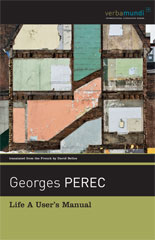
Life A User's Manual


Life A User's Manual [La Vie mode d'emploi] (David R. Godine/Verba Mundi, 2009)
by Georges Perec [translated from the French by David Bellos]
France, 1978

"Is he having us on?"
Gabriel Josipovici.  "Georges Perec's Homage to Joyce (And Tradition)."
In The Yearbook of English Studies, Vol. 15 (1985), Anglo-French Literary Relations Special, p. 188.

Getting to know Georges Perec, the author of Life A User's Manual and hence the object of an incipient man crush on my part, through the reading of his most celebrated novel, I frequently found myself asking: Georges, where have you been all my life?  In between such possibly spurious moments, I really did laugh out loud and shake my head in disbelief throughout this work in appreciation of its extreme inventiveness and sheer narrative exuberance.  Oft labeled an "experimental" novel on account of its jigsaw puzzle-like structure and the fact that most book bloggers are too lazy to consider reading it, Life is perhaps better thought of as a sort of distant cousin to the reader-friendly likes of The 1001 Nights, Boccaccio's Decameron, and Ovid's Metamorphoses.  An exercise in storytelling for storytelling's sake.  A vast storehouse of stories enhanced and enriched by imaginative allusions to other stories and storytellers. While one thread of the ingeniously-constructed plot revolves around millionaire British eccentric Bartlebooth's fifty year project to assemble and then disassemble a series of 500 seascapes-turned jigsaw puzzles in an act of futility that may or may not hold any special meaning for him, another has to do with Bartlebooth's neighbor, associate, and puzzlemaker extraordinaire Gaspard Winckler's plan to exact revenge on the Englishman for some unspecified reasons.  As new details about the struggle between these "two senile monomaniacs churning over their feigned histories and their wretched traps and and snares" (250) begin to emerge from the void (seemingly bringing order to the descriptive chaos), the narrative itself takes on the shape of yet another 750-piece puzzle as it mimics the form of French artist Valène's scarcely less ambitious plan to paint the Parisian apartment building where all the principal characters live as if it were a giant doll's house with the facade removed: room by room, object by object in painstaking detail, as imagined at a moment in time later to be revealed as the precise moment of Bartlebooth's death.  The result is a mystery--or if you prefer, a puzzle--fragmentarily assembled in such a way that all of the characters' neighbors and many former inhabitants of 11 rue Simon-Crubellier become an integral part of the extended cast with a corresponding domino effect on the storylines that's just incredible to behold.  And the result is a mystery--or if you prefer, a puzzle--told in such a way that while the painter's perspective often seems to double as the narrator's, woe to the careless reader who succumbs to the page-turning charms of the story and doesn't take note of all the funhouse and trompe l'oeil effects Perec's set up as snares along the way.  Just a super fun read that makes me want to smack my lips and say...C'est magnifique!  (http://www.godine.com/)

Georges Perec

A Technical Note
I had some story-related thoughts I wanted to add here regarding Perec's use of altered quotations as a form of creative "plagiarism" and the significance of Gaspard Winckler's revenge and such, but I think I'll save those for the comments box if anyone in our little readalong group would like to discuss them.  For now, though, I'd like to touch on two technical aspects of Life A User's Manual that continue to blow my mind.  First, the constraints.  Many of you are probably aware that Perec imposed a series of constraints upon himself during the writing of this novel.  Although it's easy enough to find information on this in English online, I'd like to direct your attention to this French site here for the best one-stop visual grid I've seen of the various tables Perec used to pair specific author references and other allusions throughout the novel (my favorite categories: missing and false, two "wild cards" if you will).  To see how the table's used, click on any of the contraintes, say "citation 1" or "citation 2" or "couple 1" or "couple 2," to view the authors that needed to be cited or the "couples" (Laurel and Hardy, crime and punishment, etc.) required to be mentioned chapter by chapter throughout the entire novel.  Just nuts!  Second, I'd like to return to the Knight's Tour mentioned earlier in the month when I was first getting into the novel.  You don't have to know anything about this technique to appreciate Perec's storytelling for its entertainment value, but once again, man, is that crazy!  However, the extremely-observant Isabella of Magnificent Octopus recently pointed out that Perec seems to have "cheated" on one of his moves.  Her question: What happens between chapters 65 and 66?  Although I tried to figure this out using Perec's hint that a "little girl" was to blame for this problem, I couldn't figure out what he was talking about since the page numbers cited didn't have anything to do with my edition of the novel.  Doing a little detective work last night on JSTOR, I came across the answer and learned why it was such a mystery: it has to do with French wordplay that got lost in translation!  Bear with me for this fairly long but quite elegant explanation courtesy of Paul A. Harris:

A more consciously contrived perturbation in the formal structure of the book is that while the building has 100 rooms, Life A User's Manual has only 99 chapters.  The room described in the text, found at the extreme bottom left corner of the 10 x 10 board, would be the 66th chapter.  At the end of chapter 65, a list of knickknacks concludes with a square biscuit box on which a girl is seen "munching the corner of her petit-beurre" (318).  The girl has nibbled off the corner of the board map for the book, eating the chapter in the process.  The connection between the biscuit box and 10 x 10 square of rooms is conveyed through an operation of verbal transformation favored by Perec, that of homophones (see Magné 1986, 61-62).  In the original, the square tin box is "fer-blanc, carrée" (Perec 1978, 394); the result of the girl nibbling is "faire un blanc dans le carré" (Magné 1990, 14).  And the whole conception of this clinamen is contained in a pun in French, for one "pièce" (room and/or puzzle piece) in the book can't find its place--a foreshadowing of the piece that Bartlebooth dies holding, the last piece in a puzzle whose shape is an X, while the blank space forms a W.*

So what the heck is a clinamen?  I'm glad you asked because this further exposes the fine line between Perec's sense of humor, genius, and "madness"  if you ask me!  According to my trusty handbook, "For Oulipians, the clinamen is a deviation from the strict consequences of a restriction.  It is often justified on aesthetic grounds: resorting to it improves the results."  So far, so good--but check this out.  "But there is a binding condition for its use: the exceptional freedom afforded by a clinamen can only be taken on the condition that following the initial rule is still possible.  In other words, the clinamen can only be used if isn't needed [underscore added]."**  On that note, I'm off to bed but will be eager to discuss Life A User's Manual with any and all concerned in the morning (send me your links!).

*Paul A. Harris.  "The Invention of Forms: Perec's Life A User's Manual and a Virtual Sense of the Real."  In SubStance 23(2), Issue 74, pp. 63-64.
**Harry Mathews and Alastair Brotchie, eds.  Oulipo Compendium.  London: Atlas Press, 2005, p. 123.

un petit-beurre, yummy
(naturally, "lu" also means "read" [past participle] in French, ha ha!)

jueves, 1 de abril de 2010

April Shared Read: Life A User's Manual


Just a quick post to mention that my "non-structured reading group" cohorts Claire, Emily, Frances, Sarah, and I will be reading Georges Perec's celebrated 1978 novel Life A User's Manual [originally published in French as La Vie mode d'emploi] in April as part of our monthly shared read program for 2010.  Any and all are welcome to join in, with the discussion slated to take place on participating blogs on Friday, 4/30.  Will refer those interested in a quick introduction to the work to the U.S. publisher's website here and direct those interested in a more studious appraisal of the novel, a Three Percent review which also includes a brief overview of Perec's career, here.  Won't say too much more at this point other than that the little I've read of Life A User's Manual so far combines a dizzying storytelling virtuosity with a prankish sense of humor.  Am beginning to understand why Caravana fave Roberto Bolaño often hailed it as one of his favorite novels, but those interested in a more middlebrow seal of approval should note that Life A User's Manual is also included on that sketchy 1,001 Books to Read Before You Die list so beloved by lemmings everywhere.  Anyway, hope you can join us!